1841 – 1861
Notable Events
1840 – Rebuilding the Farmhouse from Plas House
1842 – A Ghastly Accident
c.1845 – The Age of Photography
1848 – The British Association for the Advancement of Science
1850 – St. Paul’s Church
1851 – New Swansea Guide Description
1854 – More Photography
1855 – The Death of John Henry Vivian
1857 – Death of a Scullery Maid
It is hard to know how the house & estate changed during this period. We have two notable sources. We have the unpublished 1851 Vivian Estate plan and we have a physical model of the house, now in Swansea Museum that was constructed in the late 1860s.
From the 1851 Estate plan we get a firm plan of the house and grounds with a date. This is the first plan that shows the the ornamental garden’s path structure had been established and the fountains added where they remain to this day.
The main thing to me that the plans of 1851 show, is the stage of development of the house. At this time the west wing has grown since the 1837 tithe map and has developed north to take in the southern building of the stable range. There are only three differences between this plan and what was sold to the council in the 1920s, so it’s safe to think of Singleton as being “complete” by the 1851 plan and that John Henrys final plan for Singleton had come to fruition.
The actual dates of the completion of the west wing and northern bedrooms cannot at this point be established any further than the window between the 1837 (surveyed) tithe map and the 1851 estate plan.
Rebuilding the Farmhouse
In 1840 a large amount of stone became available from an old building within the center of Swansea. This old building has been known by many names, but we shall call it Plas House.
This mansion had a long history and was said to have been built in the medieval period of Swansea’s history, within the walls of the castle. With the stone acquired from Plas, Vivian pulls down Singleton Farm House and rebuilds it in Robinson’s style, using the said material. This included windows and doorways and other stone detailing.
This can be proved by viewing the stone in situ at Singleton Farm and comparing it to the drawings of Plas House, as well as from letters of the time. More info on Plas house can be found here. I imagine Vivian taking a certain bit of satisfaction from taking the old front door of the Plas and installing it as a dairy door to his farmhouse.
I dare say that John Henry would have smiled a bit when entertaining guests around his estate and pointing to a doorway and telling how Oliver Cromwell himself had used this exact doorway on his visit to Swansea. I think in a way it demonstrates John Henry’s resourcefulness of a sorts, using the past to propel himself forward. John Henry himself having a portrait of Oliver Cromwell within Singleton.
In April of 1840 a ball was held at the ball-room (dining room) of Singleton. Of the some 200 attendants were the Duke and Duchess of Roxburghe, Lord and Lady Fitzroy Somerset, Lord and Lady James Stuart, Sir Minto and Lady Farquhar, Sir John and Lady Guest, Lady and Miss Morris, and others.
In late 1840 the Lord Bishop of St Davids stays at Singleton for a few days as the guest of JH Vivian (Cambrian 21/11/1840). It isn’t possible to know exactly which rooms John Henry would have given over to his guest as a main room. Possibly the rooms to the front of Singleton, but maybe also the suite of rooms that later would be remodelled for the Royal Visit in the 1880s.
William Gibson Craig had married John Henry Vivian’s daughter Betsy and they had a child born in Singleton in September 1841. The newspapers note that while at Singleton William Gibson Craig shot a woodcock in the grounds during the first week of October.
A Ghastly Accident
A ghastly accident took place in mid-March 1842. The Cambrian reports that:
“A fatal accident: on Monday last a young man named John Davies a cartman in the employ of JH Vivian Esq. MP was driving a cart within the Singleton Park, he was asked by a woman permission to put a bag of sand in the cart, to which he assented. Afterwards he asked the woman to come into the cart, and as she was going up behind, the cart tilted which cased the horse to take fright”
“The fence against which the cart was driven, and by which a considerable length of railing was thrown down, was composed of horizontal rods of iron, that were forced apart from their rivets by the violence of the shock; and it was the end of one of these bars that unfortunately entered the chest of the driver of the cart, who was running by the side of the horses. The team was hired by the day”
The death must have been quite shocking to the family and represents one of the first traumatic accidents to occur at Singleton that have been recorded. It is impossible to say where it occurred due to the type of railing being used throughout the estate due to the prevalence of livestock. More deaths however, were to follow.
In September of 1842 the sad news was received at Singleton that John Henry’s only brother Lieut-General Lord Vivian had died at Baden Baden on the 20th of October. The Cambrian reads “his lordship was in his 67th year and was one of the most distinguished of out General Officers. Up to the dissolution of the late Ministry his Lordship held the post of Master General of Ordnance.”
In June of 1844, the Cambrian notes the certain incident taking place: “On Thursday after-noon, the 30th, as two boys were amusing themselves with a gun, kept in one of the garden houses[lodges] in Singleton grounds for destroying of small birds, the piece accidentally went off, lodging its contents in the leg of a boy names William Jones, son of Morgan Jones, joiner, residing near Bryn. Upwards of 60 shots entered the calf of the right leg, many being lodged deep in the muscles. Fortunately, the blood vessels escaped injury, as also the knee joint. A surgeon was sent for, who promptly attended and extracted many of the shots.”
A police case in 1845 gives us some of the names of the staff of the estate and the extent at which it is coming along. In a court case where a labourer had been charged with stealing metal from the estate we learn that John Henry Vivian had some 1500 copper pieces marking trees and shrubs throughout the estate. These pieces of copper had Vivian’s stamp upon them and were painted and presumably written on to record the type of plants they hung from. Mr Thomas Anne (gardener) gave evidence in the case as did John Williams (servant in employ of the Vivians) – it was John Williams’ daughter who is thought to have stollen the material and later sold it on in town.
Photography – the first photographs
By the mid 1840s we start seeing photographs of Singleton and the surrounding area via the likes of Calvert Richard Jones, who learnt of the process through a neighbour who was a cousin of the Talbot family. William Henry Fox Talbot had invented the process during the 1830s.

© Victoria and Albert Museum, London

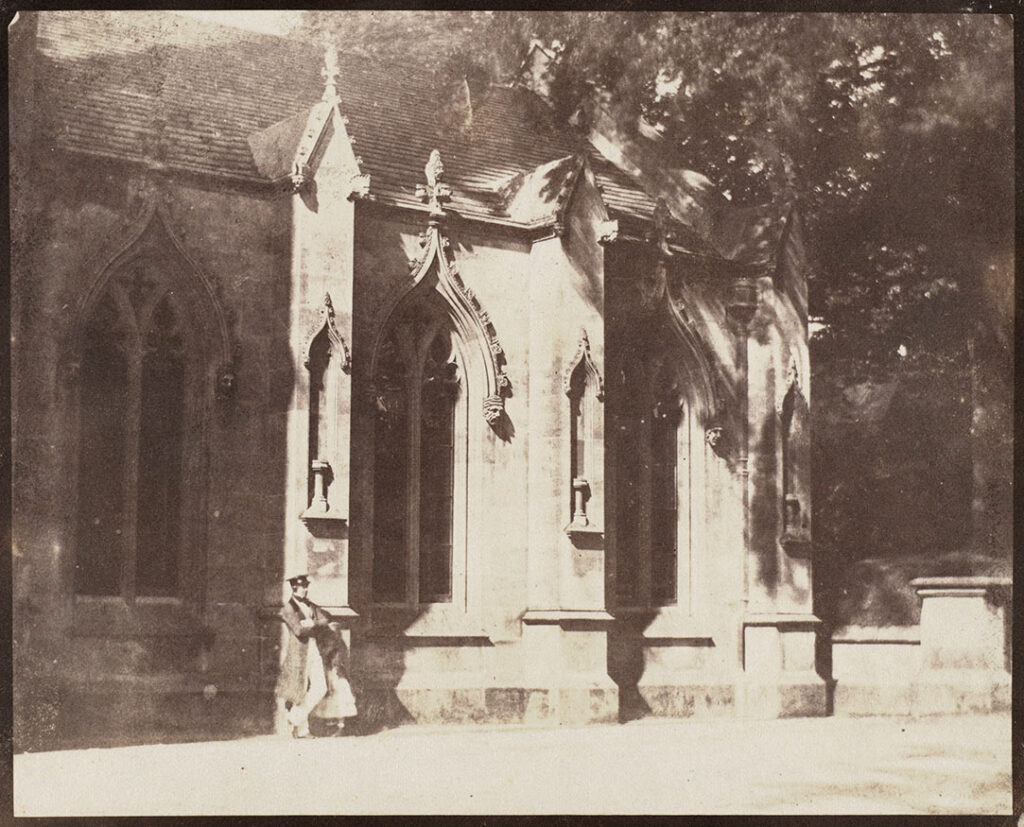


In January 1847 Lord & Lady James Stuart visit Singleton with Miss Stuart, Mr Herbert Stuart and Mr F. Tighe from Cardiff Castle. At the end of July, John Henry is joined at Singleton by John Bright, M.P. of the anti-corn law league.
1848 would start off well for the Vivians at Singleton. Festivities at Singleton are reported in January and on the 4th of February Viscount Adare M.P. leaves Singleton after a stay. By the 2nd week of February the newspapers would carry the news that of a birth, “at Singleton, the lady of Henry Hussey Vivian, Esq., of a son and heir”. But things quickly soured for on the 1st of March the newspapers would carry the sad news of a death “at Singleton, near Swansea, Jessie Dalrymple, the beloved wife of H.Hussey Vivian Esq. The sudden and premature death of this amiable and youthful lady has plunged the family of the respected member for Swansea into the deepest affliction and has produced a universal feeling of sorrow and sympathy throughout the town and neighbourhood”.
John Henry Vivian had been in the process of renovating the house to his north, known as Wern Eynon, or Veranda House. Newspapers and stories of the day indicate that John Henry had demolished the original house and was in the process of rebuilding when Jessie passed away. At this point only the servants quarters had been established and John Henry quickly abandoned the project, instead converting the building into accommodation for this garden staff, principally being the home of a James Harris, the soon to be head gardener of the Singleton Estate. The lands of the house were then given over to plants from all over the world.
British Association for the Advancement of Science
In August 1848 Swansea was home to the Eighteenth anniversary of the British Association for the Advancement of Science. Among the visitors expected are Prince Louis Napoleon who, with a distinguished party, were to become the guest of C.H. Smith Esq of Hendderwen; M. Guizor, who was to be entertained by Henry Grant, Esq of the Knoll; and the Marquess of Northampton P.R.S who has, with a number of other distinguished personages, accepted the invitation of J.H.Vivian Esq MP at Singleton Abbey.
The week’s activities concentrated mainly on lectures and meetings. Lectures were given on Thursday: Mathematics and Physics, Chemistry, Geology and Physical Geography, and Mechanics.
Followed on Friday by: Mathematical and Physical Science, Chemicals, Geology specifically covering local coal, Zoology & Botany, Statistics, and Mechanical Science.
A very curious note from the Saturday’s notes included Electricity and Motive Power for Vessels and the Pembrokeshire Herald and General Advertiser states:
“One of the most interesting of the excursion was that to Penellergare, the mansion of JD Llewellyn Esq about five miles from Swansea. The boat, which was impelled by the electrical current was the principal object of attraction. It was not constructed for the purpose, but was the boat ordinarily used on the lake for pleasure purposes, capable of conveying six or so persons, and the construction of which is due to JD Llewellyn (the host of this scientific party) and to our talented countryman Mr. B Hill.”
“This boat was capable of carrying seven persons but on this occasion not more than five were in at one time. With this cargo the speed at which it was propelled was 3.5miles an hour – a speed some of out readers may think not very great, but it must be recollected that the boat was not constructed for fast sailing.”
There were many other trips into the local area on the weekend, with many of the works being thrown open to the poking and investigation from the parties as tghey split up throughout the county.
Monday saw a return to lectures, Mathematical and Physical Science, Chemical Science with its Application to Agriculture and the Arts, Geology, Botany, zoology and Philosophy, Statistics and Mechanics. Tuesday, more maths and zoology and mechanics. Wednesday Geology, zoology and botany.
At the end of the meeting it was to be said that Swansea had done very well for itself, and that it had received similar attendance to meetings in Southampton, and more so that Plymouth and Cork had received which “was received with loud plaudits.”
In the spirit of the above abundance of Zoology lectures, in 1849 the Cambrian newspaper reports that on the 22nd of June that a sturgeon was caught at Singleton by Robert Sparks. Later in the year on the 30th of August flying ants were so prevalent over the Singleton estate that, according to the Cambrian they “covered a considerable area, and actually darkened the air for the time being”.
St. Paul’s Church
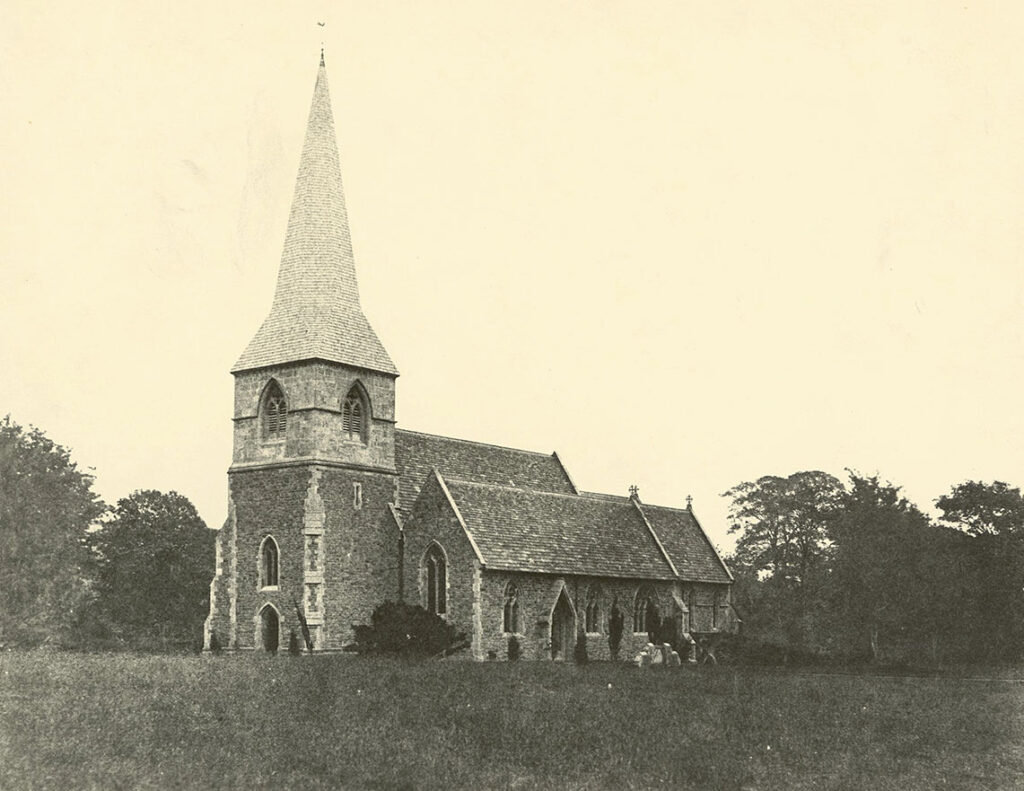
“Built to the designs of architect Henry Woodyer. It was consecrated in 1850 and became the parish church in 1851. It was enlarged in 1908 and 1929 to include aisles, chancel and vestry.
The church is constructed of snecked, hammer-dressed local stone with Bath stone ashlar. It consists of tower with broach spire, nave and chancel in line – as originally built – with the addition of north and south aisles, flat-roofed vestry and gabled porch to north, and south chapel to chancel; the latter is a Vivian family burial chapel. The interior is spacious with tiled floors and open arch-braced roof to nave, aisles, and chancel. The nave has five bays, the arcade with octagonal piers with ball-flower capitals. Stained glass includes works by Hardman (1856) and Kempe & Tower (c.1923).
The Vivian chapel is dominated by the standing white marble figure of Jesse Vivian (d.1848) by Pietro Tenerani.”
- Extract from Cadw Listing description
© Amgueddfa Cymru – National Museum Wales
22nd June 1850, Singleton hosted “a large party at a public breakfast at Singleton, and permitted all to wander through the delightful grounds which are attached to his hospitable mansion. A regatta followed in the harbour”. This large party were in Swansea for the opening of the South Wales Railway.
24th August 1850, one of the local papers states: Sketty New Church – this handsome little edifice which adjoins the Singleton ground, is fast drawing towards completion. It is expected it will be opened and consecrated about the middle of September, on which occasion the Lord bishop of St David’s will officiate in person. The resident minister will be the Rev. Mr. Sandford, anexemplary young clergyman, and college friend of Mr Hussey Vivian, the principal promoted of the chuirch
Singleton was also the home to cricket matches, in 1847 Hussey Vivian was injured in a game between Swansea and Neath, and in 1850 Singleton was home to the 2nd innings of a game against the 77th Regiment, where the first innings had been played on Crymlyn Burrows the day before.
The 1851 New Swansea Guide Description of Singleton
“Singleton Abbey, the seat of JH Vivian, Esq., who has represented Swansea and the Western Boroughs of Glamorganshire for upwards of twenty years in Parliament, is situated about 2 miles on the road to the Mumbles. The house stands at about a quarter of a mile from the road, on a slight eminence, commanding a most beautiful view of the entire bay. The grounds, stretching to the northward and westward for a considerable distance, undulate in the most varied manner, affording many charming points of view; and being kept in perfect order, both art and nature combine to render Singleton a most delightful and fair spot. The Florist and Botanist will find much to occupy his attention in the garden surrounding the house, which is laid out with the greatest taste and contains a very valuable collection on rare flowers and shrubs. Indeed, it may justly be said that here:
Strangers are readily admitted, if the family are from home, on requesting that a gardener may accompany them. On the terrace, a brass 24 pounder, recovered from the wreck of the Royal George, with the shells still adhering to it, may be seen, which is well worthy of observation. The house itself is built in the Elizabethan style of architecture. The license which this style admits in regard to additions on no former pre-concieved plan, has been largely availed of, and the broken effect this produced is most pleasing. Cliffe describes it as “one of the most perfect places in the kingdom on a moderate scale – a triumph of art”; and certainly, one thing has been obtained, viz., the combination of perfect comfort and elegance with moderate size. The house is fitted up in keeping with the date of its architecture, and contains many good paintings of the Italian and Flemish schools.”
1852 –Ball held at Singleton
In 1853, the first proper school in Sketty was established. This was the Sketty National School at Stewart Hall, just down from the current petrol station. According to a Cambrian Daily Leader article from 16 May 1919 “[In Veranda House] here the first Church School of Sketty was commenced, in the laundry over the coach-house. This was prior to the erection of the old Sketty National School by Mr. John Henry Vivian M.P.”
To quote the National Library of Wales Journal:
“Swansea, in common with similar industrial centres in South Wales, experienced the universal problem of the Works vs the Schools, i.e. the works always attracted more boys than the school because employment was always available, and offered quick rewards. A natural result was the thin attendances in the higher classes, and Vivian did his utmost to counteract this evil by introducing evening classes”
The listing document for the building describes it as:
“Former school with attached hall to rear. School dated 1853; attached hall circa 1930. School by Henry Woodyer, architect, of London and Guildford. Distinctive symmetrical Victorian Gothic composition.”

Photograph taken by Captain Lennox
More Singleton Photography
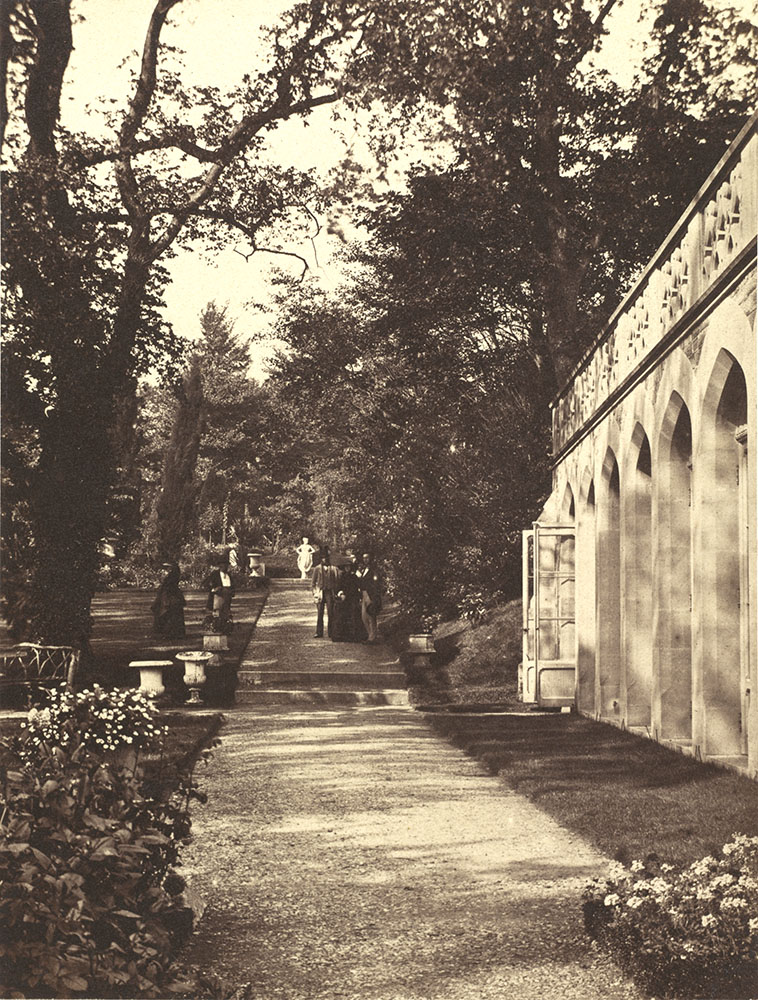

The photograph above-left was submitted to the Photographic Exchange Club in 1854 by W. Graham Vivian (1827-1912). It was submitted with the following caption:
Taken on collodion in September 1854; weather bright; Exposure two and a half minutes; developed with Pyrogallic Acid
Lens by Horne and Thornthwaite; focal length fifteen inches; diameter two and a half inches; Diaphragm half an inch

©Victoria & Albert Museum, London

CC0 / Llyfrgell Genedlaethol Cymru – The National Library of Wales
Death of John Henry Vivian
On the 16th Feb 1855 the Cambrian announced the death of John Henry Vivian
“This day will long be remembered in the annal of this locality – the day on which we discharge the solemn duty of announcing the death of Mr Vivian… on Saturday last, at 6pm, at this seat, Singleton, John Henry Vivian Esq., M.P. for Swansea and its contributory Boroughs, departed life.”
“JH Vivian was born on the 9th August 1785. Swansea has therefore to commemorate, through with vivid regret, the death of her first representative, at the tipe age of sevenry years. In 1816 Mr Vivian, who was then in his 31st year, married the eldest daughter of the late Arthur Jones of the Priory Reigate, Surrey, and of the Brynn, in this county. The syurviving family, which now endyures the suffering incident to the loss of a devoted hisband and unsurpassed father, consists of his widow Mrs. Vivian, his el;dest son H.Hussey Vivian MP for Turo, his eldest daughter Lady Gibson Craid, his second daughter mrs Jones Lloyd, his second cond Mr W Graham Vivian, Arthur PEndarvis, Richard Glynn, Henrietta Letitia Victoria and Dulce Vivian.
Born and reared in Cornwall, imbued with the love of metallurgic enterprise, by which for ages that country has been distinguished, the mind of Mr Vivian was early directed to Science…
We first find that about the year 1825, at the age of 40, he became Magistrate and Deputy Lieutenant of the county of Glamorgan, and was appointed High Sheriff for the County in the year 1827. By these dates it is proved that Mr Vivian must have passed the twenty years which intervened between the 20th and 40th years of his age in the pursuits of science, and in devotion to business at the Hafod Copper Works, near this town…
Before the date of the Great Copper Trial in the year 1833 at Carmathen while engaged in the pursuits of discoveries designed to improve the manufacture of copper, and more especially with a view to suppress “the smoke” incident to the process that he formed a close intimacy with the late Sir Humphrey Davy, Professors Brandle and Phillips, and the presents Dr Faraday. The last philosopher was entertained at Singleton on the occasion of the late meeeint of the British Association in this town – twenty years after his visit to the Haford for the purpose of preparing evidence for “The Trial”…
IT was during the early period of his life that Mr Vivian laid the main foundation, after designs by Mr [P.F.] Robinson, architect, of that elegant and noble mansion which ever since has borne the name of “Singleton”. Before this time, on the site of the present house, there existed a residence under the name “Marino”. How magical the transition from the past to the present!
He was and ardent advocate of the cause of popular education. In his practical conduct as an employer of many hundreds of workmen, these principles have always been strictly observed. But in no campcity did the character of Mr Vivian shine forth with such vivid brilliancy as in that of a promoter of all local ccharities in institutions. This trait of munificence distinguished his career early in life. It was t he oyutflowing of an inborn charity. Even long before his elevation to the membership of Swansea, his donations to the cause of local institutions were handsome to profussion. For thirty years has his liberal spirity marched pari passu with the extension of this town. No single building, whether Chriuch of Chapel, whether an institution to educate the massers or a school to train the young, or a prison to correc the offender, or a hall to shelter and to echo the voice of the people, has ever since been raised to which his hand has not been profuselt munificent. By his own unaided resources, a few years since, at Vivian Town was raised a school capable of accommodating 600 childrenl since that time, by himself and by his eldest son, a Church and School-house have been erected at Sketty, which for ages will enshrine their princely spirit “in memoriam”
15 February 1856 SWANSEA TOWN COUNCIL: MR VIVIAN AND LAND NEAR THE EASTERN ENTRANCE TO SINGLETON.
21 March 1856 DUKE OF ARGYLE ARRIVES ON A VISIT TO SINGLETON, SEAT OF H.HUSSEY VIVIAN.
22 August 1856 JOHN CROMBIE APOLOGISES FOR LETTER TO MRS VIVIAN,SINGLETON RE J.M.LEEDER .
05 June 1857 SWANSEA BOARD OF HEALTH: RE.PROPOSED DIVERSION OF STREAM AT SINGLETON. MR VIVIAN & WATERWHEEL..
Death of a Scullery Maid
The papers of the day record, in June of 1857, the sad death of the scullery maid of Singleton, one Jane Taylor. Jane was 18 years old, and her father was living in Llangennith. The case is interesting in that it gives us a glimpse into the running of a household of the era. Her body, found on the beach in front of Singleton, and her death suspected drowning.
During the case, several interesting witnesses were called. First was Ellen Case, and she is quoted as saying “… Jane Taylor who was a scullery maid at Singleton, Mr. Vivian’s. I have been there for the past four months. I was not employed in the kitchen but in the house. The deceased was at Singleton when I came there. I last saw the deceased about 12 o’clock on Tuesday in her bedroom. The deceased then had her bonnet and shawl on. I asked her if she was going out and she said yes, she was going up to the farm. I saw her go down the stairs for the purpose of going out. I have no had any misunderstanding with the deceased at all. The bonnet and shawl which the deceased has on now is the same I saw her put on”.
The 2nd witness was Henry Brooks: “I am butler in the employ of Mrs. Vivian, of Singleton. The deceased was scullery-maid there. I think she had been there about 10 months. I saw her leave the house a little before 12 on Tuesday last, with her bonnet and shawl on. I saw her pass up towards the stable yard, the way she would have to go to get to the sands. The deceased was particularly quiet and obliging girl, bore an excellent character, and was a very respectable person. She appeared perfectly happy and cheerful”
The 3rd witness Elizabeth Butcher: “I am kitchen-maid at Singleton. I have been sixteen months in the service of Mrs. Vivian. The deceased came on the 29th of January last. I last saw the deceased about 12 o’clock on Tuesday last. We were then in the kitchen. We had a dispute about a shilling; I accused her of having taken a shilling from my room near the kitchen. She denied having done so. I told her I could swear to the shilling amongst a thousand and had marked it, and she then confessed that she had taken it and gave it in change for half a crown to Miss. Jenkins the needle-woman. I asked her if she would go to Mr. Graham Vivian with me and my fellow servants; she said “yes willingly”. This was before she confessed to having taken it. I afterwards went into the scullery, when I saw the deceased at her work, but I di not speak to her. I did not inform Mr. Graham – I marked the shilling because I had missed some before. Deceased did not cry when I accused her of taking the shilling. I never had any previous quarrel with her. I have asked her before this if she had seen the money and she had said “no”, which satisfied me at the time”.
She was declared by the jury to have been in a fit of temporary insanity, and they concluded that she had killed herself at the beach by throwing herself into the water. A very sad state of affairs.
31st July 1858 – The fashionable and interesting sport of archery will be pursued in Singleton Park on Wednesday the 14th August, when the society’s prizes will be shor for; after which, with the kind invitation of Mrs. Vivian, a dance will take place.
On the 21st of August the newspaper concludes with – The members of this flourishing and influential club held their Second Grand Bow Meeting, the last for this season, on Wednesday on the beautiful ground of Singleton, near Swansea, the residence of Mrs J.H.Vivian. The meeting took place under very brilliant auspices. The weather was delightful, and the sport worthy of the days of chivalry. The object of the society is that of bringing together, twice or three times a year, the leading families of the county, without detailing any heavu expense upon any on person. This was the principle actyed on the present occasion, as well as at the first meeting, helf at Dunraven Castle. The targets were fix3ed at one oclick in a sheltered spot in the park, just under the farm. The ground was enclosed and interspersed with spacious marquees, whiulst to impart eclat to the event, two bands were in attendance,MR Grenfells and Mr Hallam’s, whist inspiriting alternative strains proved a great acquisition and contributed much to enliven the proceedings of the day.
The proceedings of the day were brough to a close by a large part partaking of the hospitality of Singleton and engaging in the “festive dance” which was kept up with much animation”
The list of people is quite extensive and it obviously added to the article in the paper to enphesise the whos-who in attendance: the Earl and Countess of Dunraven, the Vivians, Bruce Pryce, Dillwyns, Grenfells, Berringtons, Morris, Moggreidge, Edens etc etc.
I can find no mention of archery at Singleton before the passing of John Henry Vivian. It remains to be proved if the archery lawn at the rear of Singleton was created before John Henry Vivian’s death, or was done by Sarah Vivian after. The 1851 estate map does show a lawn laid out, but if its function was for archery, I do not know.
During the late 1850s and early 1860s, there are quite a few reports of the Swansea Rifle Corp on field days, maneuvers, or just marching at Singleton. By the later part of 1860 battalion sized drills were being conducted.
On the 16th of November the Cardiff and Merthyr Guardian record the following:
“Volunteer Review near Swansea – The beautiful grounds of Singleton were the scene of a most interesting and exciting military spectable on Wednesday, the occasion being the official inspection of Colonel Vivian’s battalion my Major Roney, the Inspector of Volunteers for the South Wales District. The volunteers mustered 600 stronbg, and constituded as fine a consolidated battalion as is to be found in the United Kingdom., Having, after a pleasant march, reached the grounds, the battalion was drawn up in open columns of companies right in front, and, after being equalised, they were orderd to wheel into line and fix bayonets”.
After the inspection by the officers the following is said:
“The usual evolutions were then steadily performed, the manual and platoon, as well as the volley firing in companies and in line, being remarkably good, and eliciting marked commendations.”
After some kind words by Major Roney, some 750 people were seated for a meal in the nearby marque.