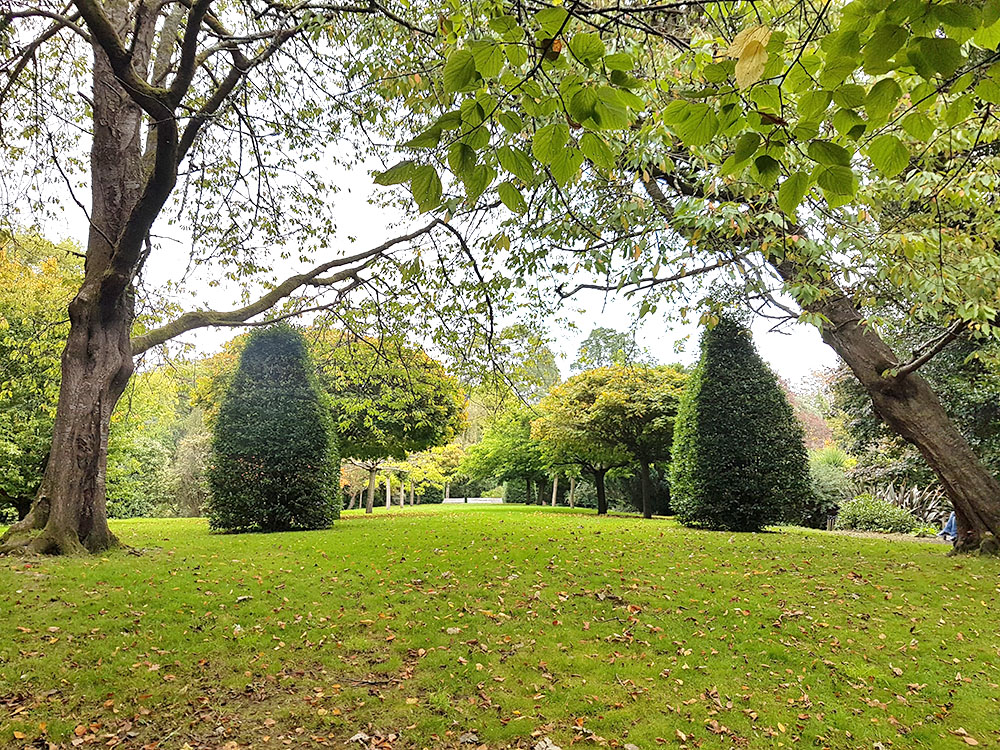
Note – I have tried to link the mentioned plants/species to wikipedia, RHS, Kew webpages, to allow the reader to better understand the actual plant. In some cases I am not 100% sure if I have the right plant/species linked as the older names used in the original source are not always still in fashion.
SINGLETON ABBEY
The house itself is of modern construction, it having been built and the whole place made by the late Mr. Vivian. The front door is surrounded with a spacious yard or wide piece of gravel, and this is belted with trees and evergreens, amongst which Chimonanthus fragrans and Viburnum Tinus lucidum have grown into conspicuous specimens. On the south front there are many flower beds & grass terraces, and trees of numerous sorts. In some of the beds Tom Thumb and Flower of Spring Geraniums stand out all the year round, and they look better now than plants that have been protected. Magnolia conspicua and M. grandiflora grow luxuriantly and flower abundantly as standards.
The climbers growing against the house attract much attention. As if to throw all the others into the shade Pittosporum Tobira has ascended 20 feet with the same width, and it produces its lovely scented flowers in great profusion. The yellow and white Banksian Roses have grown most luxuriantly as they are about 40 feet high and cover a large space. The Malmaison Rose has also grown about 20 feet, and so has the Lemon-scented Verbena. Flower beds abound on both the south and west sides of the house, and some of these are effectively filled with Geraniums, Calceolarias, Verbenas, etc, but many of them contain old-fashioned Petunias, Heliotropes, Carnations, and other sweet-scented flowers. Magnolias are forming fine standards on the west side of the house ; M. conspicua has attained a height of 25 feet and the same in width.
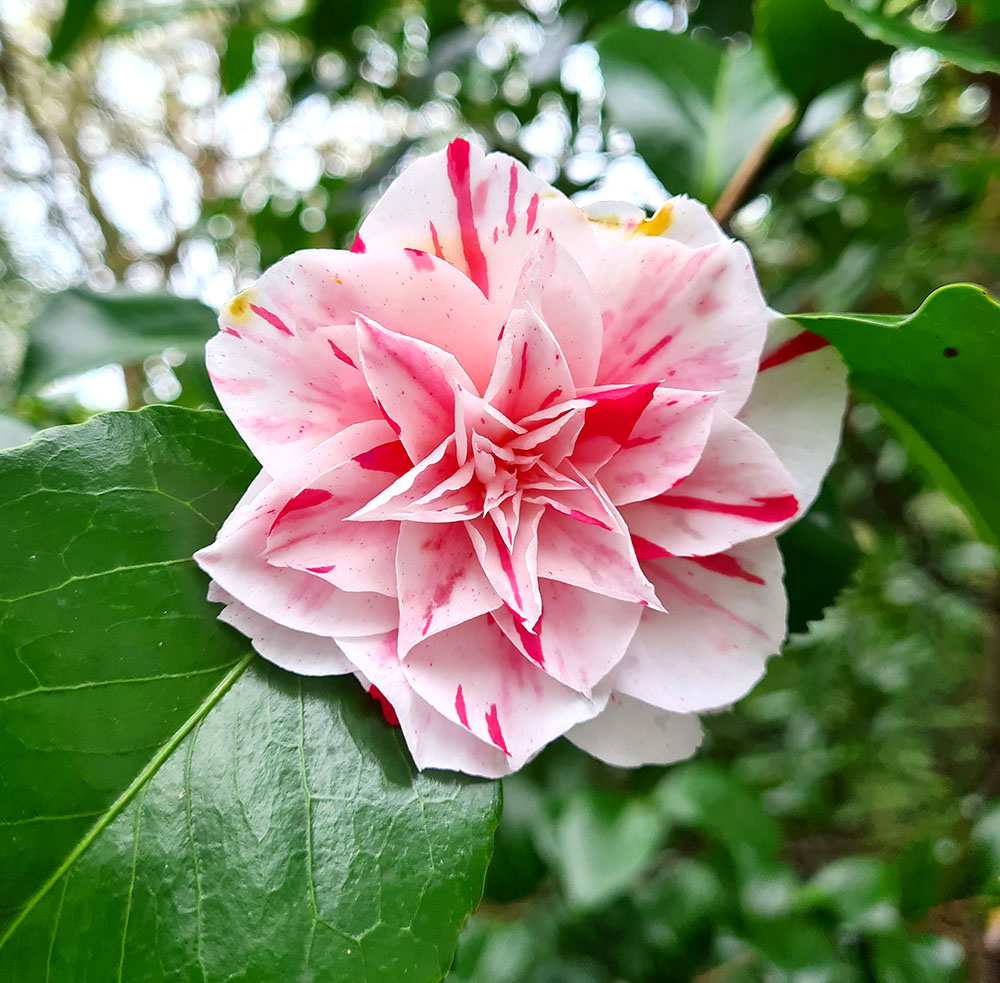
Close to the flower beds attached to the house and elegantly draped with climbers is the conservatory, a structure 60 feet in length. It contains some fine specimen Camellias, Tree Ferns, Orange trees, and many other plants; but here there is no need to go under glass to find rare specimens of vegetation, as they adorn every nook and corner in the open air. Several of the Indigoferas are doing good service as climbers against the end of the conservatory, and so is the Climbing Devoniensis Rose, which flowers very freely and is never pruned or restricted in growth in any way. Many of the finer sorts of Clematis are also used as climbers. On the west side of the conservatory there are some splendid specimens of Camellias both growing in boxes and planted out in the ground. The position is rather exposed to the sea, which is only about 400 yards away, and the winds sometimes injure the leaves of some of the trees, as is the case with some Hollies, Laurels and Bays close to the Camellias, but not a leaf of the latter has been touched, and here the Camellias are regarded as the hardiest of shrubs.
Going northwards from the conservatory by shaded walks beautifully overhung with choice trees and shrubs we come to the archery ground, a fine piece of grass, and pass on to another flower garden. There are no finely trimmed carpet beds here, but there are many features equally attractive. Round the center fountain all kinds of sweet flowers are growing luxuriantly, and Roses hang in long wreaths from pillars. In the bed which surrounds the fountain Yucca gloriosa is finer than ever we saw it, and so is Y. filameutosa, many dense clumps of them being as much as 24 feet in diameter, and the mass of flowers which they produce has a very imposing appearance.
The lawn tennis court is situated at the end of the archery ground. Looking through a long vista of trees we find a most effective terminal group of Palms, including grand specimens of Latania borbonica, Seaforthia elegans, Sabal umbraculifera, also Dractena Cooperii and D. australis. As an edging to this tropical-looking bed fine plants of Begonia Rex appeared to great advantage, as they were growing freely and were nicely coloured. From the west side of the house a walk leads to what is called the Crataegus garden, which contains fine specimens of nearly every species of the Hawthorn. Time, however, would not allow us to inspect this fine collection, and we could only look in their direction and at the same time admire the beautiful wood of Clyne and the magnificent castle of W. G. Vivian, Esq., which lay in the distance.
Still going north from the house we arrive at another flower garden ; but like the others there were no glaring masses of colour, the beds here and there being intersected with all kinds of choice shrubs. Yuccas, Palms, Araucaria exoelsa, A. Cunninghamii, and Cycas revoluta. The last-named Cycad was not protected in any way during the winter, and it has thrown up many young fronds this spring. The double-flowering Cherry is a great feature when in bloom in spring, some of the trees being 40 feet high and as much in diameter. Further north and completely hid from the last flower beds there is a Rhodo- dendron garden containing many fine plants both in size and variety. Argeuteum, Gibsoni, Falconeri, Dalhousii, Countess of Haddington, and Edgeworthii are amongst the leading sorts grown. Many of these Himalayan Rhododendrons that are usually grown in greenhouses are 20 feet high and as much through ; they are growing luxuriantly and bloom profusely. Azalea indiea does equally well planted out. At one end of this Rhododendron garden is a large slope arranged as a wild garden with rocks, ferns, and wild flowers.
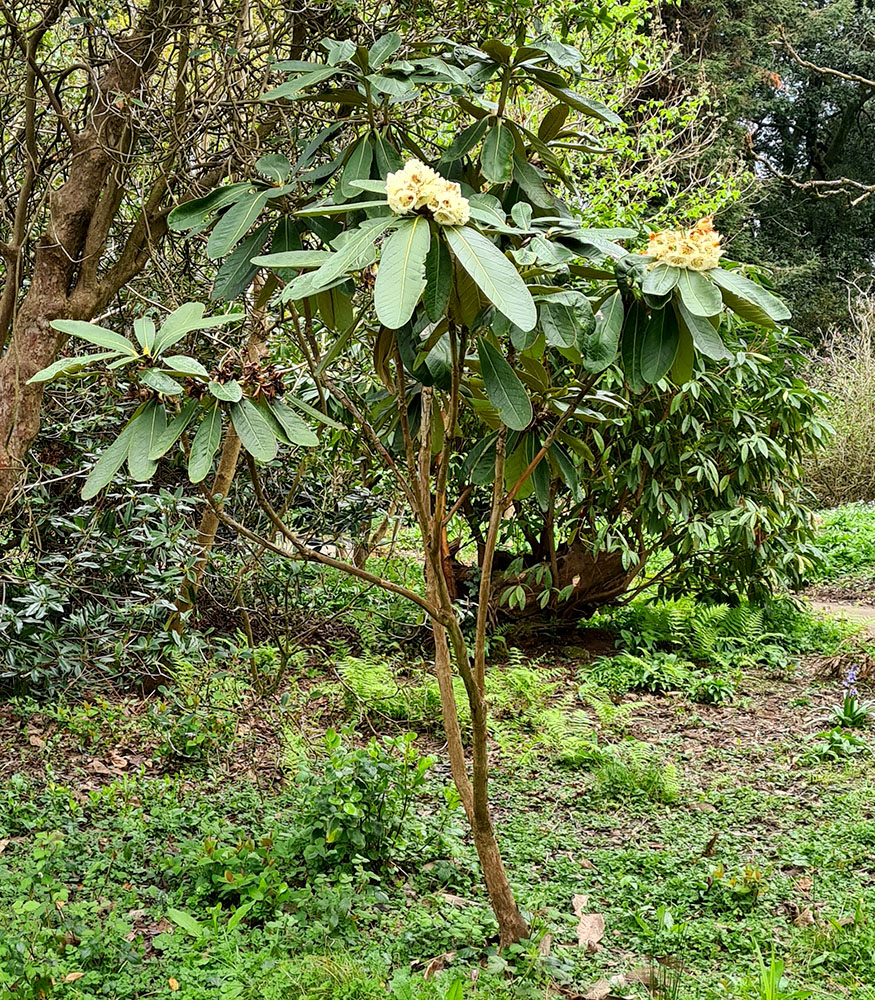
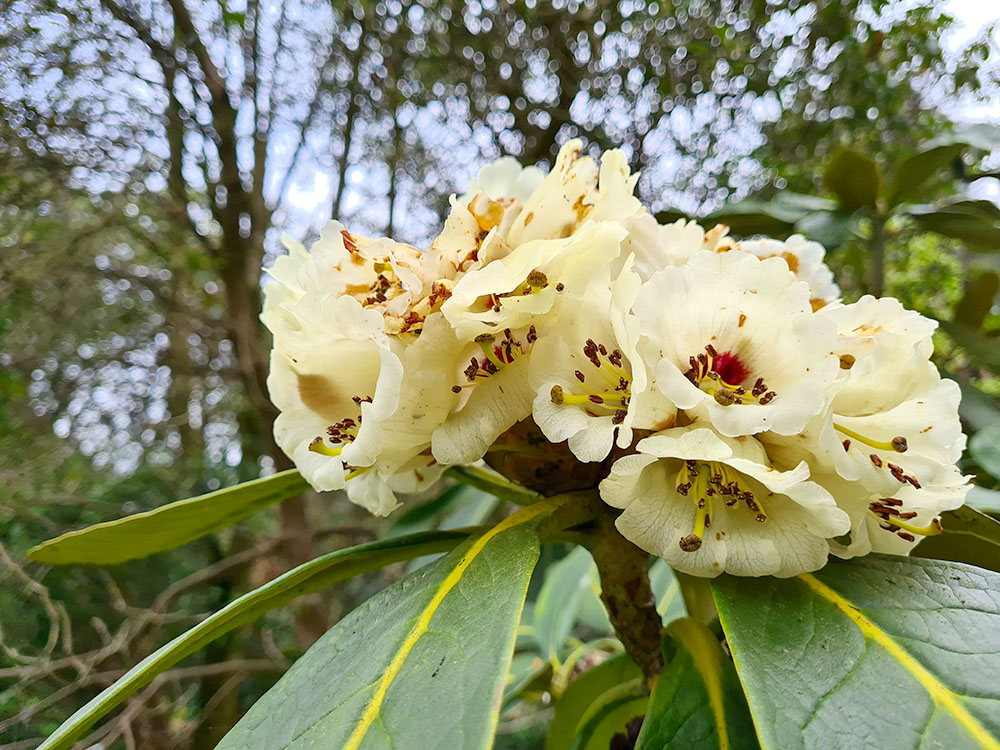
Leaving this and winding our way through various walks to the east side of the mansion we came to the pinetum and another large garden of Rhododendrons. Many of the shrubs here are the same as those just named, with the addition of some grand specimens of Rhododendron Thompsonii, R. campanulatum, and R. barbatum. All the best of the hybrids are also planted, and when in bloom in spring produce a rich effect. Ghent Azaleas are mingled with the Rhododendrons, and Azalea mollis forms a beautiful edging to some of the beds. Many of the large Rhododendrons and Araucarias 25 feet high were transplanted from crowded places into more open positions last winter, and not one of them appears to have sustained the slightest check or injury. Space will only permit a few of the finest specimens of Coniferae being named. Pinus Menziesii, 60 feet ; P. grandis, 70 feet ; P. exeelsa, 70 feet ; P. insignis, 100 feet high, 40 feet through ; P. Morinda, 55 feet ; P. Pinsapo, 40 feet ; P. Sabiniana, 40 feet ; Cryptomeria japonica,. 30 feet by 20 ; Thuja Lobbiana, 35 feet ; Cedrus Deodara, 90 feet ; Taxodium fastigiatum, 80 feet. Many smaller specimens are growing plentifully, and help to constitute the finest and most extensive arboretum in South Wales.
The kitchen garden and glass houses are about 400 yards from the mansion. The houses are in three ranges, two of the ranges being span-roofed and the other lean-to houses. The vineries are six in number, and are altogether about 180 feet in length. They are mostly devoted to a single variety of Grape in each house, such as Black Hamburgh, Foster’s Seedling, Muscate of sorts. Lady Downe’s, etc. Many of the Hamburghs were cut, plenty were ripe, some just commencing colouring, and others recently thinned. All are bearing very fine crops, and the Vines are in a highly creditable condition. In one of the back ranges Peach trees occupy an important part. Most of the early fruit was gathered, and heavy crops of later were coming well on. At the end of the Peach range there is a large span-roofed greenhouse. Many Marechal Niel Roses are planted out, and their usefulness for supplying cut booms in spring cannot be over-estimated. The body of the louse was filled with a variety of healthy plants of the kinds generally used for decoration in greenhouses at this season of the year. The next range we enter, a span-roofed plant stove, where Caladiums, Dracaenas, Begonias, and many fine-foliaged plants are growing freely, and their high colourings are relieved with the soft green tints of many choice Ferns. Bound some of the shelves Maiden-hair Ferns are planted out, and they do much better in this way than in pots.
The next house is a successional Pine pit containing many fine plants. Cucumbers grow along the back wall and bear wonderful crops, and at the further end from the door is a collection of Orchids, amongst them the Aerides and Vandas are particularly fine. The next house is a large three-quarter span-roofed Pine stove. Mr. Harris is regarded as the best Pine-grower in Wales. Scores of Queens were in fruit, some of them green, others ripe. Not one of them would weigh less than 4 Ibs., and many of them over 5 lbs. In fact the average may safely be taken at the last figure, and those who are practically acquainted with growing Queen Pines will understand that to have scores of fruit averaging 5 lbs. a-piece is no mean achievement. Mr. Harris depends a great deal on atmospheric moisture and water at the axils of the leaves to develop the fruit properly. The soil in which they are growing contains a good admixture of peat and a little horse droppings. Moscow Queens and Smooth Cayennes were much larger than the Queens, and altogether they reflect the highest credit on Mr. Harris, who was the premier prizewinner for a single fruit at the great Preston Show.
The kitchen garden is about four acres and a half in extent, and replete with fine crops of all kinds of vegetables. The brick walls are substantial and well covered with finely trained healthy fruit trees. The Peach trees on the open walls were especially fine, and although the cold winds had injured the leaves tiie crops of fruit are heavy. The kinds are chiefly Royal George, Noblesse, Bellegarde, Late Admirable, and Salwey. The last named comes in very late, fruit weighing three-quarters of pound having been gathered from it on November 20th. Small fruits are a heavy crop, and Apples, Pears etc. moderate. Mr. Harris has a comfortable house looking into the kitchen garden, and it is nearly hid with large Fig trees which generally bear heavily.
Many names and dimensions of plants and other features worthy of note have been omitted in these brief notes, but we do not think that any person could visit Singleton without coming away with our impression, that Mrs. Vivian possesses a remarkably fine garden, a gardener highly worthy of encouragement and a conviction that this is given and fully appreciated. — Visitor.