1882 – Rhododendron, Singleton and Woodcuts
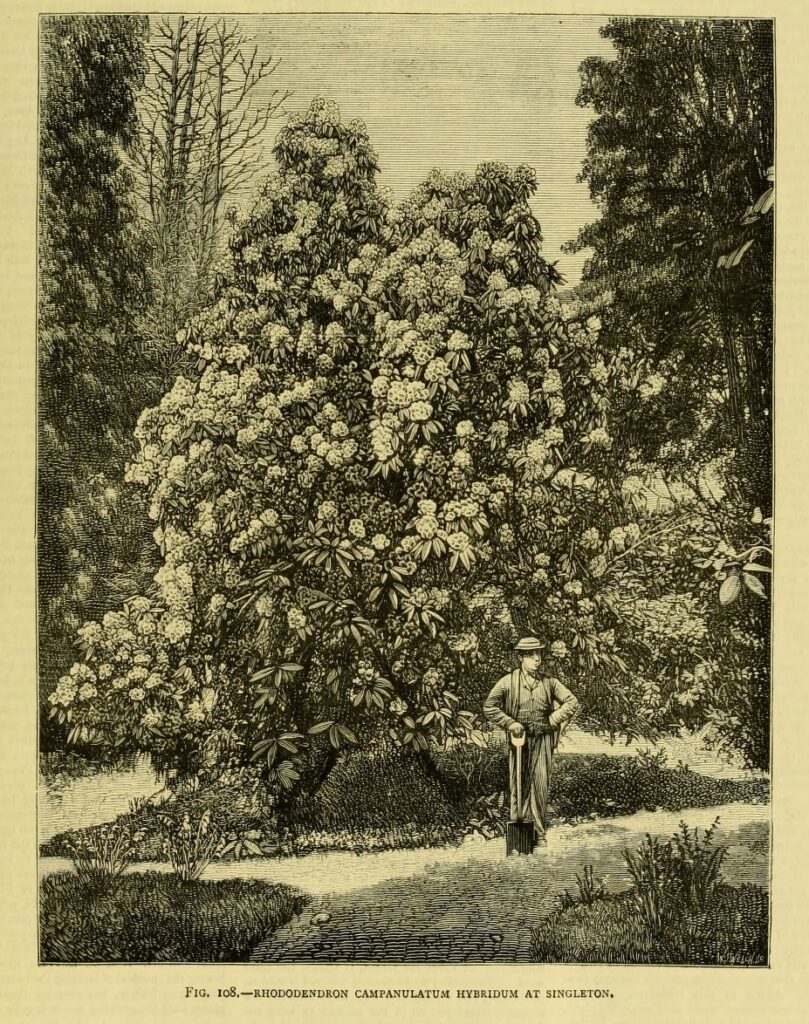
The accompanying woodcut is a faithful reproduction of a photograph taken of a Rhododendron at Singleton, near Swansea, and will be interesting, not only on account of the intrinsic merits of the plant, but because also, alas I it was so seriously broken in the great gale of last October as to necessitate its removal ; we may, however, solace ourselves with the reflection that though the largest it was by no means the only example of this fine variety grown in Mrs. Vivian’s gardens.
I believe that it originally came many years ago as a small seedling plant from Van Houtte, under the name of campanulatum hybridum, with some others of the same strain, which were called campanulatum nobile, campanulatum robustum, &c., but whatever may have been its parentage it was at the time of its destruction a handsomely furnished tree 20 feet or upwards in height, and its floriferousness may be well judged from the representation.
Speaking of this plant a year or two ago I heard Mr. Harris, who is in charge of the gardens at Single- ton, say that he had known 200 trusses cut from off this one tree for the decoration of the neighbouring church at Sketty on Easter Sunday without their being missed — a statement then received as an exaggeration, but I, knowing Mr. Harris’ accuracy and that I might depend on what he said, asked him at Easter, 1881, to count with me the trusses of bloom then on the plant : we found upwards of 1 100, and think there were nearly 1,200, but it was a difficult matter to reckon exactly.
But it is not for its size and floriferousness alone that it is so well worthy of notice. In judging the respective merits of the hardy hybrid Rhododendrons we are attracted by certain qualities of colour, shape, texture, habit, and size, which in our critical eyes give one variety precedence over another ; and bearing in mind Mr. Glenny’s floricultural standard of what a Rhododendron should be — “that the individual flowers should be round, slightly cupped, large, well-spotted, smooth-edged, and thick ; colour dense, and truss a bold round-sided cone ; footstalks thick and elastic,” and proceeding to compare the subject under notice with this description, or with the many other fine hardy hybrids which grow in luxurious profusion in this paradise for Rhododendrons — we may safely pronounce it to be one of the finest in cultivation. For each truss is large, conical, and handsomely set up ; each pip is large and full, of good shape and texture, and the colour is a good bright white, darkly and effectively spotted with rich purple.
I fear that its early flowering habit would condemn it in the eyes of some of our fanciers, for modern Rhododendron growers aim at obtaining their blooms in May and June when comparatively safe from the bane of spring frosts, and they can describe their plants as hardy, and obtain a grand display of all their glories blooming simultaneously. But as this hybrid blooms at Easter, the end of March and beginning of April, it has a point of merit in my eyes as being one of those varieties which help materially, and]which are so welcome, in prolonging the blooming season of the queen of our flowering shrubs by anticipating the main body and affording a foretaste of the glories to come later on in the season.
John T. D, Llewelyn,