1881-1900
Notable Events
1881 – The Royal Visit
1882 – A Baronetcy
1886 – The Death of Sarah Vivian
1887 – The Final Alterations to Singleton
1888 – Madame Adelina Patti
1890 – A Wedding and a Death
1894 – The Death of Lord Swansea
1896 – The Great Fire
A Royal Visit – and a 2nd Golden Age at Singleton
1881 was to be the chance for the Vivians and the Singleton Estate to shine, for a Royal visit was to occur later in the year. The reason for the visit was the opening of the new East Dock at Swansea. By May/June there was already talk in the press of the Royal party staying at Singleton. Again, due to the will of John Henry Vivian, Singleton was to be the home, for life, of his wife Sarah.
This creates the awkward situation where Henry Hussey Vivian effectively has to ask his mum’s permission to use Singleton as the Royal venue. You can see this in the way the papers of the day phrase it. The Western Mail in June even states that they “will be the guests of Mrs. J H Vivian, Singleton, the mother of Mr. H H Vivian, M.P.”. The Cardiff Times states that “the Prince and Princess of Wales will be entertained by Mr. Hussey Vivian, M.P., at the house of his mother, Mrs. Vivian, at Singleton, near Swansea.”. Later in the same month the Western Mail changes its tone to “the Royal visitors will be driven to Singleton, where they will be the guests of Mr. H Hussey Vivian, M.P., Mrs. J H Vivian having placed the magnificent family mansion at the disposal of the Royal Highnesses”. Talk of the preparations goes on from June until the actual event in October with the planning being very much done in the open, in the papers – with different drafts of the plans and letters adding their own commentary on the details.
The visit itself received a 4-page Special Edition of the Cambrian newspaper, printed on the 19th of October, the day after the visit.
This Special Edition goes into great detail, and serves somewhat of a snapshot of Swansea, and Singleton especially in detail.
The article very much goes into the greatness of Swansea, and why the visit occurs. While the reasons were plentiful, it’s Swansea’s title as Copperopolis which brought the money to the town. With over 10 copperworks on the banks of the Tawe, Swansea was producing (at one point) over half the world’s supply of smelted copper.
The Visit
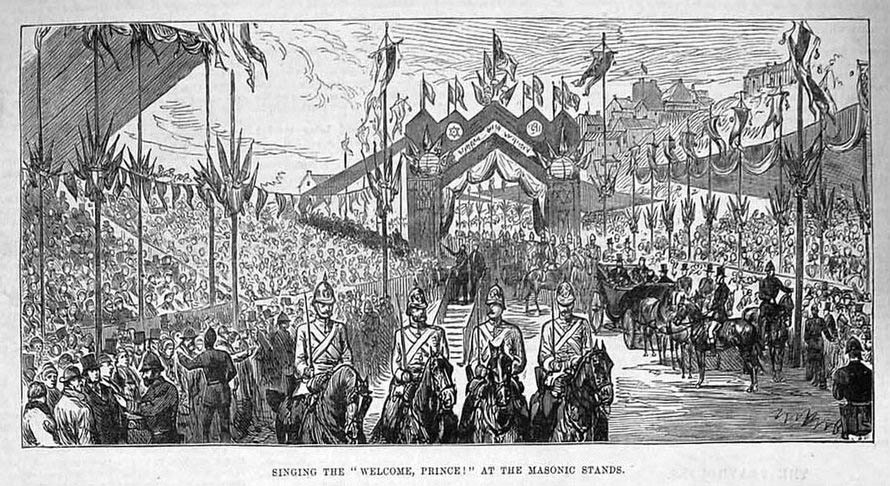
On arrival to Singleton the Prince, Princess of Wales and suite arrived at the temporary station erected by the London and North Western Railway Company outside the gates of Singleton on the Mumbles Road. As the train arrived at the station at precisely 6:45pm a Royal salute was fired from the two old French light cannons on the terrace. The guns were fired by a Sergeant Davies, drill instructor, and his two sons aged 11 and 12. It is interesting to mention that, 39 years ago Sergt. Davies, who had been stationed with his regiment in the West Indies, fired a Royal Salute in honour of the birth of his Royal Highness the Prince of Wales. The Royal party, once at Singleton passed down a corridor of Policemen holding back several hundred people who had arrived to see the Royals.
Once at the gates they entered a closed carriage drawn by four brown horses, with postillions and footmen.
In the evening a large dinner party was held, amongst those invited were:
The Duke of Beaufort, the Marquess of Worcester, Lady Emma Baring, Viscount Emlyn, Lord Kensington, Lord Tredegar, Lord Aberdare, The High Sheriff of the County, the Mayor of Swansea, the Chairman of the Harbour Trust, and other members of the Vivian Family.
The article goes on to describe Singleton in detail:
“…the mansion itself is hidden from public gaze by a thick fringe of woodlands and so it is scarcely known to the inhabitants of the district themselves. Singleton, then a much smaller house, was originally purchased by Mr. John Vivian, of Truro, and presented by him to his son, when that gentleman left Cornwall to take up his abode in Wales, in 1815. From that time until 1830 the house was very much enlarged and made substantially what it now is, a truly “stately home”.”
“…John Henry Vivian bequeathed it to his eldest son (Mr. H H Vivian, M.P.) with power to his widow to reside in it during her life. Mr. H H Vivian M.P. at present resides at Parkwern, a beautifully situated mansion on the adjoining estate, but Singleton being the larger, it has been placed at his disposal by Mrs. J H Vivian for the reception of their Royal Highnesses.”

Singleton Abbey
“The entrance porch is on the east side of the house, approached through a graveled space, dominated by a fine central stone lamp pillar, and guarded by a family of stone lions rampant, upholding brazen banners, the Vivian crest. On the threshold the visitor is greeted by the word “Salve” by which the Latins signified “God Save” the coming, “God Speed” the parting guest.
The hall is not large but is filled as indeed are other parts of the mansion, with such ancient wood carvings, armour and artistic curiosities, as remind one of the celebrated Muss de Cluny, Paris. The armoury includes old coats of mail, halberds, with scythes, and other weapons improved in the Irish rebellion, Chinese banner and matchlocks, the richly carved and coloured front of an ancient reliquary, and a curios wooden chair, carved to represent the burning of the books, brought from the Inquisition Chamber at Venice.
Among the local curiosities are a stuffed white seal killed long ago at the Mumbles, and some models by the late General Morgan of St Helens, of Oystermouth Castle, and of the Swansea Market house in Castle Square, the latter believed to be made from fragments of the very stone and Cromwellian lead of the old structure itself.
The Vestibule and grand staircase are hung with pictures by the Old Masters, including Paul Veronese, and there is a bust of the late Lord Vivia. The first door to the right gives access to the Library, a pleasant room with an eastern window. Above the well filled book cases are ranged a splendid collection of Etruscan and Florentine vases, brought by the late Mr. J H Vivian from Italy. The mantelpiece is an exquisite old wood carving, once the front of an oaken coffer. The further interest of the room is sustained by “the Street Players” by Caravaggio, a Salvator Rosa, a Rembrandt and an original portrait of Oliver Cromwell, which was found rolled up in some old title deeds, and purchased at the late Sir George Leed’s sale.
The next chamber, the Billiard-room, is hung with fine Flemish tapestry, representing the triumphs of Alexander the Great. Here, also the oak carvings are specially interesting. The Dining-room is a very large and handsome apartment, which was built by the late Mr. J J Vivian for the promised visit of HRH the late Duchess of Kent and her daughter, then the Princess Victoria, now out beloved Queen. From outside this fine room with its windows of 13th century style, has the appearance of a Chapel. Inside, the ceiling is bayed and stencilled, the floor of parqueterie, richly carpeted. The windows have been newly hung with crimson damask silk. On the walls are two large historical panel war pieces. One picture represents the death of Col. Hussey, Mr H H Vivian’s great, great Uncle, “the last of his race.” …the other picture represents the wounding of Col. Vivian, afterwards successively Sir Hussey Vivian, and Lord Vivian, at the battle of the Bridge of Croix d’Orade during the great Napoleonic wars.
Many will be interested to know that the identical blue velvet coverlet, richly embroidered with gold, beneath which Charles I. slept in Cornwall, will be placed on the Prince of Wales’s bed at Singleton. This interesting relic, together with these family pictures, have descended to Mr. H H Vivian from his great-great grandmother on the father’s died, whose maiden name was Miss Hussey, the last of her family. …the carved oak chimney piece, with Dutch spiral pillars, is a handsome piece of workmanship. The window hangings are of crimson damask silk. The rooms of the other side of the vestibule are the very retreat of the Arts. Here besides Mrs. Vivian’s own painted cabinets are works by Chambers, including “the old Swansea ferry boat,” and an early view of old Singleton. Swansea china abounds, and in the passage is a large case of fine mineralogical specimens collected by the late Mr. J H Vivian.
The drawing rooms have fine views of the park and bay to the south and west, and open upon the conservatory. The hangings and furniture are of rich yellow damask silk; and the walls are enriched with originals of Vendyke, Paul Veronese, Giorgione, S. Rosa, and the infant Hercules strangling the serpent, by Annibale Carracci [now in the Louvre]. Ascending the staircase from the vestibule we reach the corridor leading to the Royal apartments which are beautifully fitted up. We understand that the Princess’s rooms are hung with sky-blue damask silk, and the Prince’s rooms with crimson damask silk.
There are other charming rooms in the mansion – larger, indeed and with better aspects than the Royal apartments, but as we have said, they were not chosen because not en-suite. There is, for example the Chinese Room, with yellow paper of Chinese make and design, and beautifully furnished. This, we understand, was the birth-room of the present Lord of Singleton Mr. H Hussey Vivian, M.P. Beside, there are the oak room, the oriel, the blue, the green and the pink rooms. Of the kitchens, the servants’ apartments, the stables etc. we should not say more than that they are large and in excellent order.
The Royal procession had entered Singleton through a triumphal arch, designed by Mr H H Vivian himself. It consisted of a Gothic arch, between two square ivy-clad towers. There is a plume of feathers atop, then the legends, “God save the Queen” and “Croesawiad calonog ich Uchelder Breniol” which is being interpreted as “a hearty welcome to your Royal Highnesses” and the German miners’ salutation “Gluch-auf” which means “luck up” or “may you ascend to the surface safely”. The framework of the arch and towers, covered with rabbit netting, has been capitally filled in with ivy twigs, the effect is simple and beautiful. In the grounds of Singleton, on Tuesday morning, about 6,000 of the workpeople of Messrs. Vivian and Sons, consisting of copper=-workers, miners etc congregated together with about 8,000 Sundary School children, to give their Royal Highnesses a hearty welcome. From this point, all along the Sketty Road the way was lined with people in a series of ranks, who lustily cheers as the Royal Party passed. The party proceeding on to the opening of the new East Dock after much festivities in Swansea itself. At the luncheon some 1,000 guests were fed hot-soups and a full cold menu of the best description. Some 17 vans of food had arrived from London along with 125 London waiters and about 50 cooks and servants.
On return to Singleton after the opening of the Docks, the Prince planted a scarlet oak, and the Princess a lime-tree in the ground of Singleton, in honour of the Royal Visit – the trees being supplied by Mr. John Shaw, of the Gower-road nursery.

After a Grand Ball at the music hall, there were bonfires lit on Kilvey Hill, and “a grand display of fireworks took place at eight o’clock at St Helen’s Field, Oystermouth road under the direction of Mr. Pain, of the Alexandra Palace, London and lasted about an hour. An immense concourse of people assembles to witness the display. The Police arrangements for the departure of the Royal Party were such that 570 constables had to be brought in from the surrounding area, to supplement Swansea’s 80 officers and constables. The Metropolitan Police were brought in to police the East Dock specifically and some 210 had come from London.
Word of the finery of Singleton must have spread in Royal circles for in November of the same year the Duke of Edinburugh was driven through the grounds after having lunched at the Grange in West Cross.
A Baronetcy
In 1882, on the 28th of April the Cambrian reads: A Baronetcy for Mr. H Hussey Vivian, M.P. Her Majesty the Queen, acting upon the advice of her Prime Minster, has been graciously pleased to confer a Baronetcy upon Henry Hussey Vivian of Parkwern, Swansea, one of the members for the county of Glamorgan.
Each time poaching is mentioned it gives us an insight into what is on the land, and again in April of 1883 we find a Thomas Kidwell of Swansea was arrested for being in Singleton with a greyhound, “urging the dog into the park amongst the rabbits”. 20s including costs, was the fine.
The Death of Sarah Vivian
11th September 1886 – Obituary from the Cambrian Newspaper
Our obituary this week contains the announcement of the death of Mrs. Vivian, relict of the late Mr J. H. Vivian, Swansea’s first representative in the Reformed Commons House of Parliament. She expired, after a brief illness, at the family mansion, on Wednesday morning last, “full of years,” having arrived at the good old age of 88.
Mrs. Vivian was taken ill rather more than a fortnight ago soon after her return from London to Singleton She suffered from catarrhal symptoms, which later on developed into acute of the left lung. Dr. George Padley, who has been the medical attendant of the Singleton family for more than twenty years, was at once called in. The symptoms from the first were serious, and especially so considering the advanced age of the sufferer. Mrs. Vivian had always enjoyed fairly goo there basis of a good constitution well preserved, and there was, therefore, hope at one time that she might outlive the attack. On Tuesday evening, however, there were symptoms of failure, which continued to increase until her death took place on Wednesday forenoon between 10 and 11 o’clock, all the members of the family except Mr. Glyn Vivian (who is abroad), being present, as well as Dr. Padley in attendance.
The late Mrs. J. H. Vivian was the daughter of Arthur Jones, Esq., of Caerfallach, Flintshire, who on inheriting “The Priory”, Reigate, left North Wales for the latter, where he resided until he removed to the “Hill House,” and subsequently to Bryn Newydd” Swansea. The late Mrs. Vivian was born on the 7th of October, 1798, and was married on the 30th of October 1816, at St. Mary’s, Swansea. Her children are Lady Gibson Craig, Sir H. Hussey Vivian, MP, Mr. W. Graham Vivian, Mrs. W. Jones-Loyd, Mr. A. Pendarves Vivian, Mr. R. Glyn Vivian, Mrs Heneage and Miss Vivian.
Mrs Vivian had resided at Singleton since the period of its erection. It was here that the Prince and Princess of Wales were entertained right royally during their memorable visit to this town. It was here that she dispensed her hospitality to all around. It was here, too, during a more than usually prolonged life, the “‘simple annals of the poor always found a responsive chord when charity was really needed. Indeed, it may justly be said of this estimable lady that “she did good by stealth, and blushed to find it fame.” Nor were her ‘good deeds confined to her own immediate locality. In the Swansea Hospital, in the Workhouse, in the Homes and kindred institutions her benevolence was active and well-known, though always most unobtrusive and unostentatious. On the news of her demise reaching Swansea, it was received with profound regret, and every mark of respect has since been shewn to her memory. The church bells of Swansea and Sketty were at once I tolled, the public buildings hoisted their flags half-mast; whilst the shipping in the harbour display the usual signs of mourning. In the Swansea Town Council the Mayor spoke of the event m feeling terms, and a vote of condolence was passed. A similar vote was unanimously agreed to at the Swansea Board of Guardians on Thursday. In the death of Mrs. Vivian the district has lost a warm friend, Society a distinguished ornament and example, and the poor and indigent a real but discriminating and judicious friend.
The funeral, which will be strictly private, will take place on Monday morning, at Sketty Church, the cortege leaving Singleton at 11, and thus the remains of the venerable lady will be laid at rest with her amiable and well-remembered husband, whose name and kindly deeds are household words among the older inhabitants of the borough and district.
The Funeral
The funeral of the late Mrs. J. H. Vivian took place on Monday last. A large number of distinguished visitors attended with their carriages to pay their last tribute of respect to the beloved widow of that honoured and generous gentleman, the late Mr. J. H. Vivian, the “Copper King,” and the worthy Representative of Swansea in the Legislative Council of the nation. By his many good and just deeds he won the respect and the esteem of all who knew him. The deceased lady was the mother of Sir H. Hussey Vivian, Bart., M.P., probably the greatest benefactor of the people of Swansea and its neighbourhood, he is the largest employer of labour in his great smelting works and one of the ablest metallurgists in the world. He has represented this county in Parliament for more than a third of a century, and the esteem in which he and the whole of the bereaved family are held was strikingly manifested on Monday last.
About one o’clock the funeral cortege left Singleton with its long train of carriages and proceeded through the grounds of the Park to the pretty church of St. Paul, Sketty, built on the verge of the Estate, and skirting the Sketty road near that village. This handsome ecclesiastical structure was erected and endowed about 36 years ago, together with the schools adjoining, to provide for the religious needs of the Parishioners and the education of the children of Sketty. Many of the children educated in those schools have now grown to middle-aged men and women and must have many times thanked the good and generous man who put within their reach that education which they received and the benefits of which they enjoy today.
A large concourse of people thronged the Sketty-road, the picturesque churchyard, and the avenues to the porch, many being dressed in mourning. About 1.30 p.m. the procession arrived at the Church. It being a private funeral, only those who were immediately connected with the family could take part in it; however, a large number of people were admitted to the church and joined in the responses and hymns, and many were much moved by the touching funeral service. First came the employees on the estate, some aged, and others in strong manhood, bearing elegant wreaths and crosses, made from the choicest flowers, and ferns that nature yielded in the beauty and perfection of its bloom. Then came the Rev. E. J. Bolney preceding the coffin, reading part of the beautiful Church of England service for the dead, followed by the family mourners and the distinguished visitors who- were invited to take part. While the mourners were proceeding down the aisle to the chancel, the organ sent forth its solemn plaintive tones to a Voluntary, tastfully played by Mr, Crier, the organist. After this the hymns 288 and 289 (Ancient and Modern) were given out, and feelingly sung by the choir and congregation, and the 90th Psalm was then read by the officiating clergyman.
This part of the service being over, the procession reformed, and while it passed out of the church towards the tomb, the “Dead March in Saul” was played on the organ. The procession proceeded to the south-east part of the church where the entrance to the family vault is situate. Over and around its entrance time-perfected creepers and the trailing rose tree had attached themselves. There was one beautiful pink rose which bloomed alone, standing as it were, like a guardian angel keeping watch this receptacle of the sacred dead. On either side of the granite step entrance to the vault were strewn a Large number of wreaths and crosses on the gazon-fleuri, which rendered the air redolent with perfume The Rev, E. J. Bolney, standing, near the entrance, read the other beautiful parts of the funeral service as the coffin, laden with splendid floral emblems, descended to its resting place. The family and friends were deeply affected. After the service, was over, the mourners entered the vault. On their retiring, a desire being expressed to view the interior of the tomb, and members of the Press and a few other persons were admitted. The coffin was polished oak surmounted with massive brass furniture. The plate bore the inscription, Sarah, widow of John Henny Vivian, Singleton. born 7th October, 1798 died 8th September, 1886,”
The bearers were the oldest employees of Mrs. Vivian.
We understand Sir H. Hussey Vivian, Bart., M.P., will shortly remove from Park Wern to Singleton.
Lots of fundraising for local charities and needs was done as always at Singleton after Sarah’s passing. An example of this is a Grand-bazaar at Singleton Abbey hosted by Sir Hussey Vivian in 1885. The cause of the bazaar was to raise money for one of the local churches in Swansea.
June 1887, Mr. Gladstone visits Swansea and stays at Singleton. Speech given on Singleton terrace, and many thousands march past.
1887 – The Final Alterations to Singleton
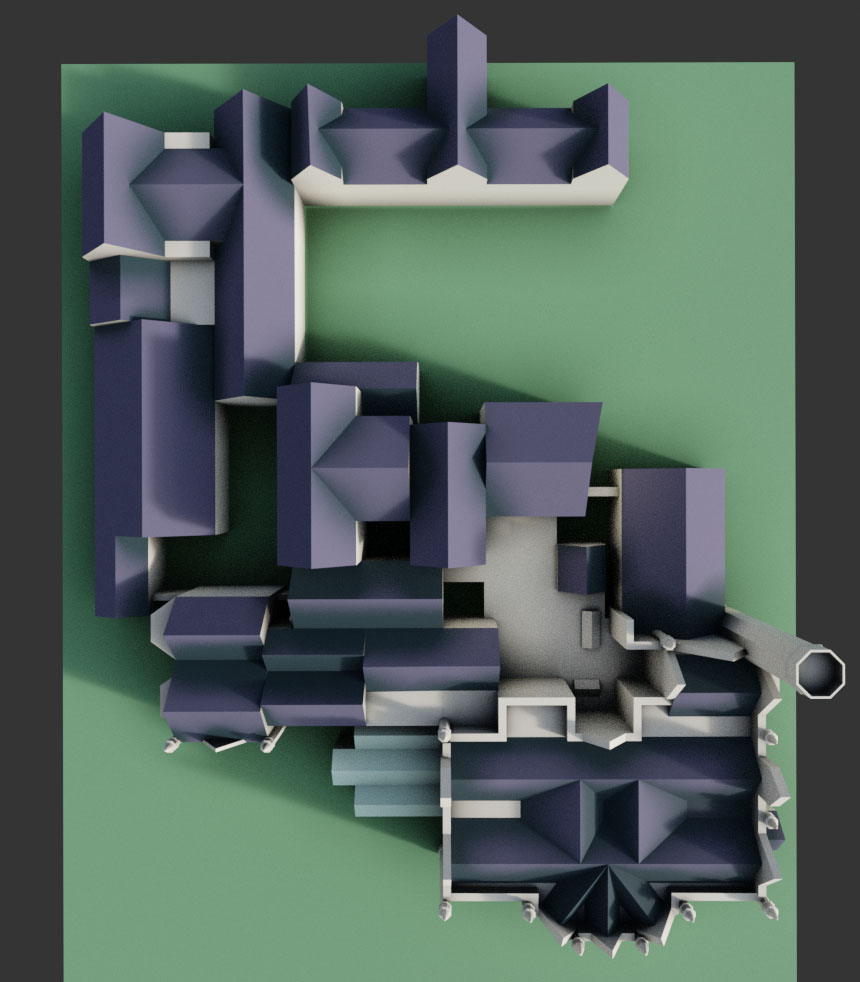
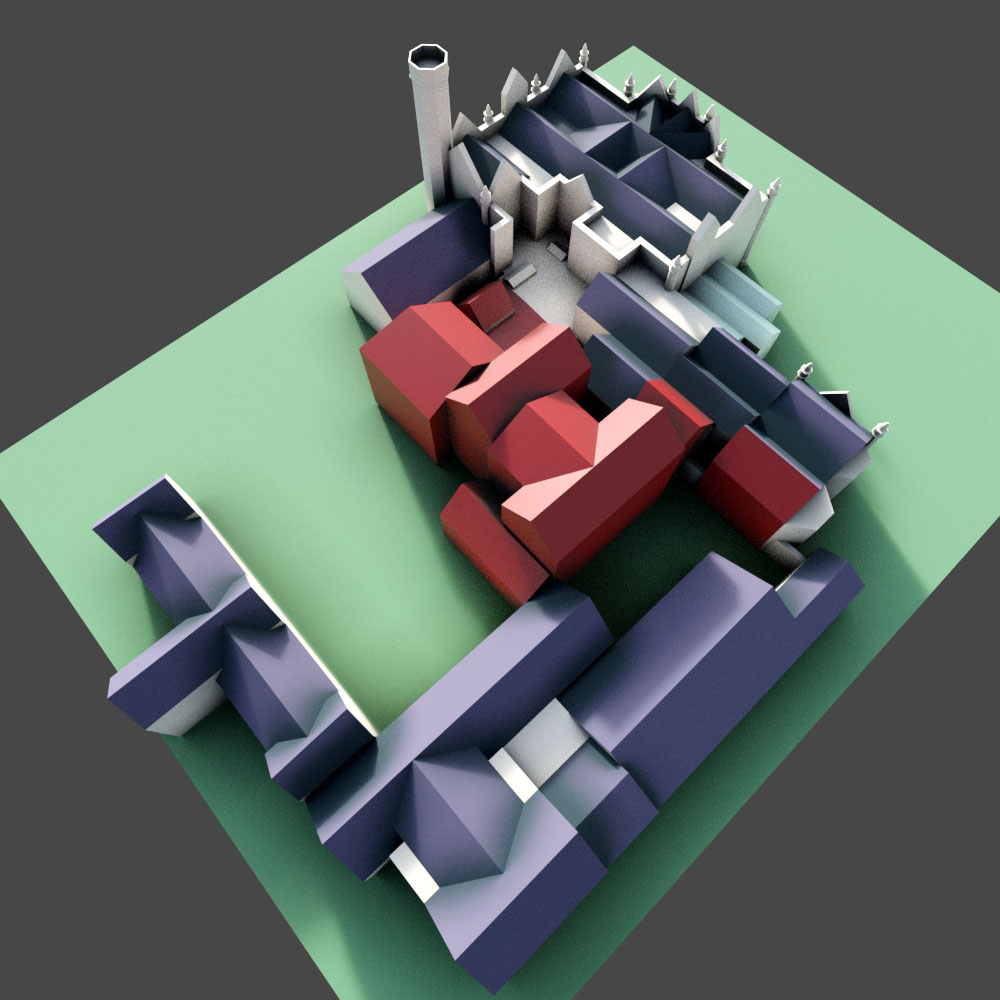
The end of 1887 would see the final changes to Singleton. Almost poetically, Henry Hussey – Lord Swansea, would build on his fathers work & home and establish his own quarters within Singleton. Building off his father’s school room/study, Lord Swansea would build a study, library and grand bedrooms over it. The building work would be completed by the summer of 1888.
The final form of Singleton
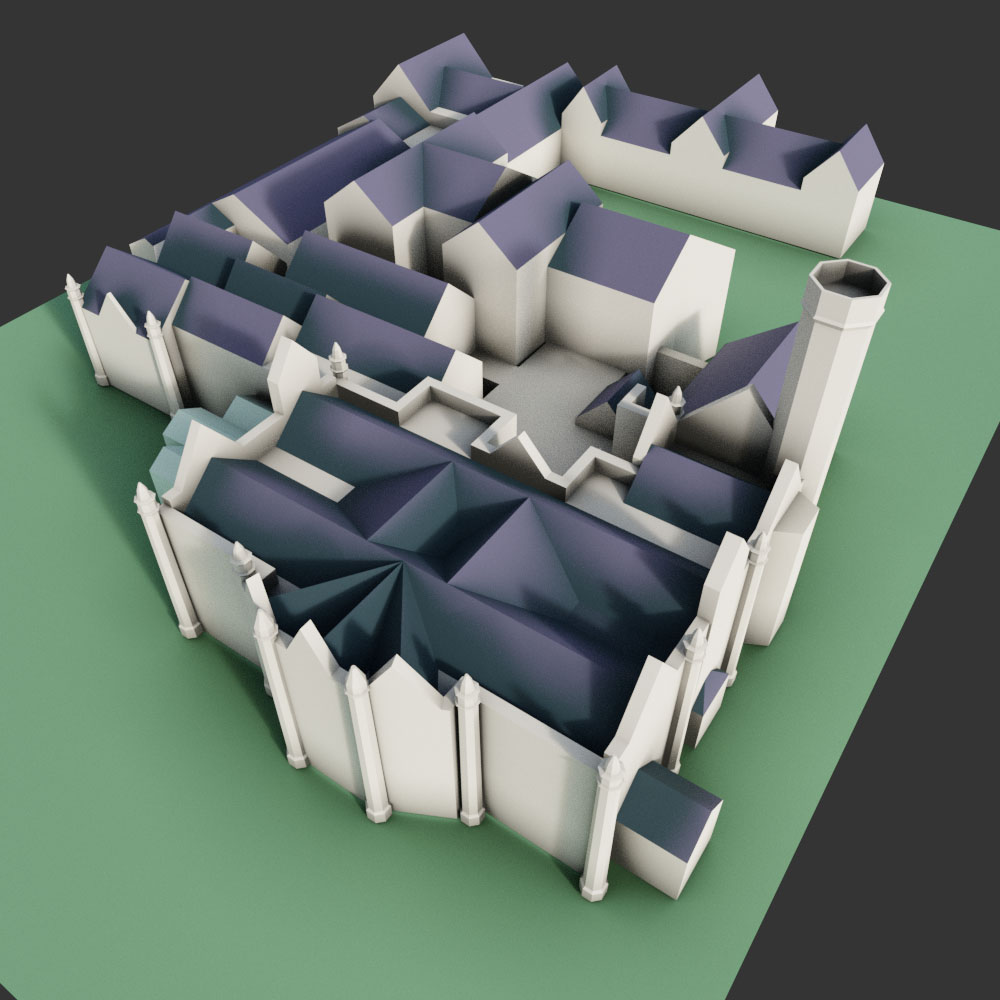
from 3D models by author
July 1888 saw the Earl of Aberdeen to stay at Singleton with Sir H Hussey Vivian
Madame Adelina Patti
September 1888 saw a grand garden party given by Sir Hussey and Lady Vivian at Singleton and among the guests were Madame Patti and Signor Nicolini and their party. The article notes specifically that great improvements have been made to Singleton since Sir Hussey took it over, and the gardens are now in their richest array.
It also notes that Madame Patti was to go to London to sing at eight concerts, 2 in London, and 6 times in the Unites States, Canada and Mexico. It was an all-expenses paid trip and Madame Patti would receive £5,600 – equal to over £770,000 in todays money.
A Wedding and a Death
The Wedding
Happy news came first for the household in April of 1890 as the Cambrian reads:
Marriage of Sir H Hussey Vivian’s Head housekeeper – Congratulations and Rejoicings at Singleton
A Very pleasing and yet somewhat pathetic event took place at Singleton on Thursday, the occasion being the marriage of Miss Alice Sophia Harris who has been head housekeep and nurse to Sir Henry Hussey and Lady Vivian for the past 16-16 years. Miss or rather “Mrs” Harris as she was familiarly known had so endeared herself to the people of Singleton, that the parting moments, though considered of a happy kind, were quite of a touching and pathetic character.
Miss Harris had made the acquaintance of Mr John Williams, a coach builder in a good way of business, and residing in Wigan, Lancashire.
The happy couple were driven to and from the church [at Sketty] in a conveyance belonging to the Vivian estate, and Sir Hussey, Lady Vivian and Mr Aubrey Vivian and family were present to witness the ceremony. It may be stated that the bvridge was given away by MR Henry Crane, head butler at Singleton. Mr Henry Short, Sketty, acted as best man, and the twice daugters and eldest daughter of Sir H H and Lady Vivian and the brisde’s sister, were the bridesmaids, and the whole of the Vivian family afterwards signed the marriage registered.
Sir Hussey, Lady Vivian and the happy couple and party having returned to Singleton, a sumptuous repast was served in the nely-constructed and beautiful orangery. The guests consistedof the bride and bridegroom and the principal servants of the household and estate, numbering altogether between 30 and 40. After a speech that brought tears to the eyes of all, Mr Hiram Williams, head-coachman, spoke of the respect in which the bride had been held by the servants of the household generally, and wished her joy on leaving after being so many years among them.
The occasion was one so great that after the couple left Singleton the staff were given permission, by Sir Hussey, to have a friendly ball.
The Death
Not long after this, in 1892 the Cambrian notes on the 29th April that:
The Vivian family of singleton live on such kindly terms with their domestic servants, and keep them so long, that it is regarded almost as a family bereavement when one of the staff dies of gets married or leaves the establishment. This week Singleton has lost an old and valued servant in the person of Mr Hiram Williams, the chief stableman, who had been in the service no less than thirty four or thirty five years. Mr Williams was of a genial and kindly disposition, and was much appreciated by the family and by all who knew him.
July 20th 1893 – Acrostic – Singleton – by Rosabelle Joseph as featured in the Cambrian:
Since childhood’s days, fair Singleton I knew,
Its lawns and mansion ope’d to public view
Never can I forget its wealth of flowers,
Growing and glowing. Its Italian bowers;
Log cottage, archery ground and Swiss chalet too
Eagle at entrance gate seemed as tho’ there it grew
Then “Salve” bid us step into the Hall
On through the Armoury, Orangery, House and all
Now Memory’s pictures do those scenes recall
The End of the 2nd Golden Period
December 8th 1893 in the Cambrian under the headline:
Robbing Lord Swansea – His Lordships Cook Purloins Some Valuable China
Hortense Edler, a cook at Singleton, and Francois Edler, a chef in a London restaurant, were charged, the former with stealing, and the latter withr eceving, knowing it to have been stolen, a quantity of valuable old china, valued at £27, the property of Lord Swansea. [Nearly £4000 today]
Through the course of the article, the court case goes on to prove that Edler, through a few different methods was smuggling plates and other china from parts of the house and posting it to London, or delivering it herself. Edler was to plead guilty and in January of 1894 would be sentenced to 2 months hard labour.
The Passing of Lord Swansea
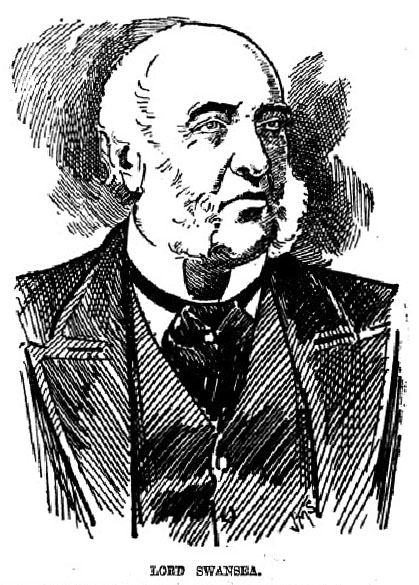
The saddest of news was to reach Swansea in the Cambrian on the 30th of November 1894.
“It is with the deepest regret that we announce the awfully sudden death of Lord Swansea, which melancholy event took place on Wednesday night at Singleton.”
Lord Swansea had been out of Swansea recently but had arrived back at 9pm to host a dinner with his guests, retiring to his room soon after 11 o’clock. Over the last two years his health had been in decline and he had been warned by a Dr Griffiths that he had a weakness of the heart and to not over do things. When retiring to rest he told Lady Swansea how glad he was to be home again. He was evidently in good spirits, but her ladyship presently noticed that there was some thing the matter, and immediately called for assistance. Before anyone arrived, Lord Swansea had passed away peacefully, though suddenly, without uttering another word.
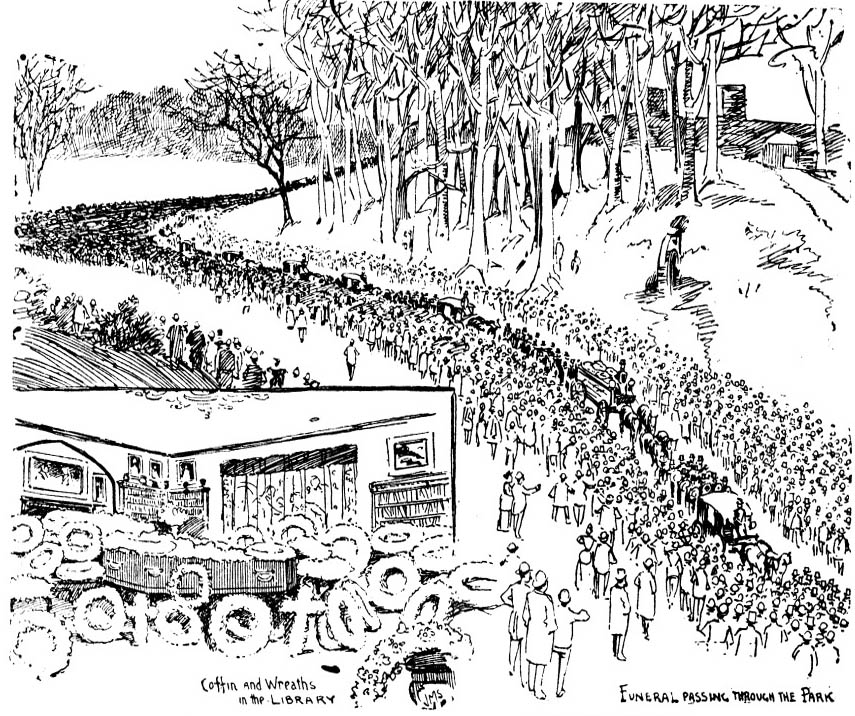
Before the funeral the body of Lord Swansea was laid out in his coffin in the Library on the first floor. In the centre of the library, with the foot of the coffin towards the high window, lay the moral remains of the first Baron Swansea. The coffin was literally under piles of the most beautiful and the most fragrant floral wreaths that it is possible to see anywhere. Those wreaths extended beyond the head of the coffin over the furniture up against the wall and then right and left over a wide area. The library indeed resembled a conservatory full of white lilies and exotics of the rarest description, and the sweet odour they emitted was far more fragrant than the incense of the altars of men’s sanctuaries.
The Western Mail writer goes on to note “one of the most touching incidents I have ever met with. Before the coffin was finally screwed down a poor old woman came to the back door of the domestic portion of Singleton Abbey and inquired in trembling tones whether she would be permitted to place a few roses on the foot of Lord Swansea in the coffin. The application was conveyed to Lady Swansea, and her ladyship, as will be readily believed, gave, with streaming eyes, her consent. The poor old woman was a lone widow to whom Lord Swansea had, at one time or another extended kindly assistance in her need. Very likely his lordship had forgotten the circumstance, but not so the Kymric widow! She brought the roses in a small wreath, and she wreathed the feet of the dead baron with as exquisite a token of heartfelt gratitude as it is possible to imagine. There is deeper significance in the token than appears at first sight. The poor woman must have bought the rooses at this season of the year, and there, she spent a “widow’s mite” in purchasing them. A finer tribute was never paid to any man’s memory”.
As the Western Mail described it “the biggest funeral procession ever seen in Swansea”. Some 6,000 people making up the host. The route from the Townhall, to Sketty Church via Singleton took the procession some 2hours to travel the three and a half miles. As the group turned into Singleton some 400 members of the choir were present, singing Welsh hymns. It is estimated, that including the 6,000 workmen of the procession, there some 50,000 people lining the streets of Swansea to mark the occasion. Once the body was loaded on the hearse at Singleton the whole procession sang English and Welsh hymns and was strung out for over a quarter of a mile.
In January of 1895 the Western Mail ran an article entitled: The Vivians of Singleton, their connection with Swansea – Interesting Particulars – Baron Swansea’s Great Property – how its management is arranged. And here are a few key points from it:
- The family fostered story goes that when the Lord Vivian branch of the clan Vivian showed their dissatisfaction with the financial results of young John Henry Vivian’s management of the concern, copper was down and comparatively profitless. Seeing that his distinguished relative were really alarmed about their shres in Swansea works and collieries, mr J H Vivian offered to buy up their interests at a certain not very high price. Within the next five or severn years Mr J H Vivian was making the “sufficiently handsome new profit of over £100,000 per anum”. [around £12million in modern money].
- The article goes on to talk about the cost of Singleton, and how Lord Swansea had conjectured that the 300 acres of Singleton, sold at £1,000 an acre would make no less than £300,000 if the family were to sell.
- Regarding the purchase of Parc Le Breos it was noted that too much had been paid for land of poor quality and much of the blood stock on the home farm was sold off.
- The article goes on to note that due to other financial issues within the family, Lady Swansea had had to give notice to very many old and faithful servants of their dismissal. Even the old folk who kept the lodges of the park are under notice to quit.
- The situation it points out was similar to how John Henry had dealt with the house, passing it to his wife.
- It comments that Old Mrs. Vivian [Sarah Vivian] was remarkable in late life for the avidity with which she sent her servants into the stewards or tresures of local flower, or butter or other farm poduce shows to claim very early in the day…. her eagerness for money got, in this way, was sometimes an annoyance to the voluntary conductors of such little shows. While this old lady this continued to live on at Singleton and her second son, Mr Graham Vivian, with her, poor disappointed Lord Swansea had to live in a much inferior house near by called Park Wern and for which he had the mortification of having to pay rent to his brother Graham.
- The Royal Visit in 1881 and Mr Gladstone’s visit to Lord Swansea were held at Singleton “by permission” of his aged mother.
The Great Fire
February the 4th 1896 was the saddest day so far for Singleton Abbey itself, as at 5am a great conflagration broke out. The Cambrian ran the headline – Fire At Singleton Abbey – A New Portion Gutted.
A breakdown of the events as reported through multiple papers of the day is as follows:
- 4:30am very slight fire seen by North Western Railway employee while walking the line in front of Singleton – went rushing to the house but house aware by the time he gets there
- Violet Vivian, interviewed immediately after the fire states “I had a little dog sleeping in my room and about twenty minutes past four o’clock I was awakened by the animals restlessness. I got out of bed to see what was the matter with it, and lighted a candle. Then I noticed that there was a strong smell of smoke in the room and looking out of the window I saw smoke rushing through a window below.”
- Violet woke her sister, her maid and then ran to butler’s room down the corridor, which was in same wing and woke Hennings the butler, Hancock one of the gardeners along with another gardener by the name of Chips. Henning and Chips went to sort the steam engine. While Hancock rushed off for Morgan Walters at the Swiss House, and for Captain Surman, the head of the Singleton Brigade. Lady Swansea’s maid, Mrs Wilson woke her to the danger.
- Violet returned to her own room but smoke was so bad she could not get back in. The papers report “The butler started to go up to my bedroom about 10-15minutes afterwards, and found that the room did not then exist. It had completely disappeared and in a few minutes all the rooms int hat wing had also gone.” Violet goes on to explain that she is very upset as she did not manage to get the dog out of her room, as she was unable to return to it at any point.
- The servants and family taken quite by surprise escape the burning wing in their night dresses and get into the courtyard, where male members of staff give them their great coats “to save them experiencing serious inconvenience”. Miss Millburn, one of the housemiads, told our reporter an interesting story of her experiences. “We just managed to get downstairs before the fire broke through into out apartment. Five or six of us were sleeping in the same part. As soon as we got out the room was ablaze and we have saved nothing…. It was a really narrow escape”
- Mounted messenger (Anthony, the under-coachman) sent to Swansea and the fire bell on the Abbey is rung
- Male servants from nearby rush to scene to help, when they get there the butler is trying to get the steam fire engine working – “it is well known, one of the Messrs Merryweather’s steam fire engines called “The Singleton”
- When the Borough Fire Brigade arrived, under the command of Inspector Davies (10 min after receiving notice) they find the butler and the carpenter (Mr. Samuel Walters) working to ready the engine.
- One of the Daily Post’s staff who lived near Singleton was awoken by “the gasping of the Singleton Abbey Steam fire engine and the wild alarum sounded by the call bell”. He got up and went directly to Singleton.
- When the Post’s staff got there he writes “when I reached the Abbey a rousing scene was in full play. From the rear of the new wing giant flames were mounting higher and even higher… Hurrying to the rear of the Abbey I fouind in the courtyard a crowd in the white-heat of excitement.
- One of the fire plugs could not be worked. The pipe had become chocked apparently with fallen leaves, and as a consequence only one hose could be played for some time
- A lack of pressure found for the purpose of throwing a sufficiently strong volume of water on the flames so had to resort to the expedient of fixing the hose to the hydrant and get water into a dam, from which it had to be pumped again by the engine.
- The Post’s writer continues, “Full steam was up in everybody as well as the engine and a couple of feeble streams of water were being poured into the part of the building which seemed to most need it. On every side however, fresh outbreaks were occurring, and it was plain to those initiated in the vagaries of fires that the flames had had a fairly good hold of the rear of the house for a considerable period.”
- Water from Swiss Pond had been sued for the steamer upuntil this point but on the lawen and terraces were cocks for standpipes and those Captain Colquhorn at one tried to tap. A Messenger was dispatched to Reservoir-lane, where the stop-tap was situated and soon the Swansea Brigade were able to bring an independent supply to bear upon the flames.
- Flames withstand the water so household work to bring valuables from the main areas of the house out on to the lawn
- At 06:30 “the whole of the rear of the abbey, was east to west was engulphed in flame”
- By 07:30, after an unremitting battling, the firemen had it subdued. Before this was done, however, the roof had fallen in, and 10 or 12 rooms, with the whole of their contents, had been absolutely destroyed.
- All of the contents of the servants offices and bedroom are destroyed “not a roof remained and nearly every passage in the whole of the rear part of the Abbey was chocked by huge falls of plastered celings and burning rafters. “the orangery and the two large drawing rooms have escaped the flames”
- As well as the contents of the bedroom of the Misses Vivian and the consequence is that the Misses Vivian not only lost their clothes, but also their jewels
- The kitchens, scullery, boot-hall, nursemaids room, Mrs Wilson’s room, the butlers pantries, the laundry, the drying room, Violet and Avril’s bedrooms, and several of the sleeping apartments which are reserved for visitors were burnt out, and only the bare walls remain.
- Water had worked its way into some of the un-fire damaged area, Lady Swansea’s boudoir being flooded with water
- Cambrian reports the origin of the fire to be the laundry, which adjoined the orangery
- At 9 o’clock the smouldering debris was still being played upon by the brigade, and now and again flames were noticed issuing from the half burnt wood frames of the windows.
- About half past 10 the firemen left with their manual engine…. Shortly after the bridage had driven away, what had hitherto been a smouldering roof broke out in a blaze, but the hose was soon playing on the flames and extinguished them.
- By midday workers from the Hafod works and other staff were busy with the removal of the quantity of half-burnt woodwork.
- 6 plus Henning the butler stay up the following night to monitor.
- All staff and family have to stay in the “old wing” for the night following, or stay elsewhere in the neighbourhood.
- The police report, according to the papers say “the cause of the fire is unknown; is supposed to have originated in either the boot or bathroom”
- The bedroom of one of the servants and that of the coachman remain intactl the safety of the former is remarkable as there were flames on either side, above and under it.
- Lady Swansea, Violet Vivian, Averil Vivian, Alexandra and Alberts Vivian and two of Lady Gibson Craig’s daughters were all at home during the fire. The family plus servants numbered about 20.
- Violet, in an interview after the event, while taking a reporter around the house said “I can hardly tell you which room I slept in, for you will see it has gone. “My sister slept in the room beneath mine, and the French governess in a room on my right.”
More details of the house are included in following reports over the coming days.
- The fire originated in the region of Averil Vivians bedroom, possibly either in the wash house flu or the bake-house flue if they became overheated. There was washing in the washroom on Monday.
- Representatives of the paper on venturing into the ruins found the laundry absolutely intact, as was the wash-house, but the boot hole was desolate – but there was no fireplace in the boot hole. Adjoining the wash-house was the laundry yard. This was formerly all covered in with a glass roof, but falling debris had left only broken framework. Part of the Orangery roof is damaged. The ruin of the servants wing is complete. The glames have worked into the premises in the shape of a V, leaving portions of the servants hall, the butlers bedroom and a few other rooms intact. The walls are standing still, but in a gaunt state with cracks evident.
- The bedroom occupied by the Hon Henry Hissey Vivian when home, which adjoined that of the Hon Violet Vivivan, has also been drestoyed. On its walls may still be seen a rifle, an ancient looking pistol, and a hand painted plate.
- No room will be regretted more than the old nursery. In it had clusterd the memories of the childhood of the late Lorsd Swansea and his brothers and sisters. The wall-paper by the wat was universally admitted. It was ideally kindergarten., The pattern represented MAdarins in various occupations and so rate was the paper – it was place on the wall before the first Baron’s time – that when ever it was damaged, by any chance, the pattern had to be painted in.
- Over a £1000 in jewellery was lost by the Vivian girls and all of the family linen and clothing stored in the linen room was lost, including some of the oldest possessions of the family. Including the Royal linen, mentioned as part of the Royal visit in 1881.
- A mason who had been engaged on the estate for 29 years said that this was the first fire that had occurred in his time, with the exception of a small out-break about four or five years ago.
- Singleton insured for £60,000 in the London Insurance Corporation and in the Royal Exchange Corporation
- It was estimated some £10,000 of damage was caused. By the end of February Mr. T.P. Martin, architect had been brought in to rebuild the Abbey.
By July the work seems to have been done as the 31st of July Cambrian posts the news that Lady Swansea and the Hon. Misses Vivian have this week returned to Singleton from their London residence.
I think it fair to say that by this time the taste of Singleton as a residence was not as sweet as it once was. What was once a mansion in 250 acres in the countryside of Swansea was now hemmed in on all sides. Traffic through Brynmill and Sketty had grown considerably over the years and where once field covered hills would have overlooked Singleton, now dense housing could be seen on the horizon.
1896 was also to be the scene for another Vivian fire for on the 28th of October Clyne Castle caught fire and a wing of the building was lost. As the Evening Express was to put it “the best portion of the house was destroyed”.
In 1897 the Swansea Assessment Committee met to decide the amounts for Singleton and others and the Cambrian notes on the 5th March 1897 that “an appeal by Lady Swansea against the assessment of Singleton at £450 gross rental and £382 10s rateable value was adjourned at the request of the appellant.
On the 5th of May of 1897 the papers carry the sad headlines that: “Lady Swansea Leaves Singleton”
Lady Swansea, accompanied by her eldest son, the Hon. Henry Hussey Vivian and her four daughters, the Honerable Violet, Averil, Alberta and Alexandrea Vivian left Singleton to take up her permanent residence at 5 Belgrave Square, London. Her departure from Swansea is very much regretted as she took a lively interest in all charitable and social functions and was much assisted by her eldest daughter. The Hon. Violet Vivian.
One of her last acts, which was deeply appreciated was to pay a farewell visit to those old people in the village of Sketty whom she had known from her advent to the neighbourhood many of whom have been the recipients of practical sympathy from her ladyship in times of adversity. Her youngest son, the Hon. Odo Vivian, remains in the neighbourhood, and will reside at Bryny, near Swansea.
By the 7th the papers announce that now Lady Swansea and her family have left Singleton Abbey, the new Lord Swansea has taken possession of the ancestral home. Servants had been sent from London a few days previous and he himself arrived on the 7th, driven as he was by his brother the Hon. Aubrey Vivian from station to Singleton in his carriage and pair.
Maybe this didn’t go entirely to plan because on the 2nd of August Singleon has been let, furnished by “an American family till the middle of September”. I think this might be the first time that Singleton had officially been “let” in such a manner.
By 1898 it was noted in the South Wales Daily Post that “since the death of the late peer [Lord Swansea] none of the Vivians have taken an active part in the public life of the district.”
In 1899 obviously still holding onto Swansea somewhat Mrs Violet Vivian, the eldest daughter of the late Lord Swansea is described as being “one of the most popular women in Swansea” and living in Sketty with her brother Odo. Her marriage to Captain Douglas Campell seems to have been very much celebrated in the district.