A Gardener’s Chronicle Article – By John T. D. Llewelyn
May and June are usually reckoned the blooming months of the hardy Rhododendron, and inasmuch as the bloom cannot be extended beyond the beginning of July I wish to draw attention to the comparative hardiness of some of the species and so-called species, from the Sikkim Himalayas, which, blooming in February, March, and April, help us to claim five months during which the lovers of this noble genus can enjoy its varied magnificence. It must be borne in mind I am now speaking of plants wholly unprotected save by Nature. The restriction of success appears to exist not so much in the climate as in the soil ; the presence of lime or chalk seems to be fatal, and beds in such a geological formation, even though carefully prepared and periodically replenished, are an expensive substitute for what in congenial soils requires little attention and care. Peat is here unnecessary ; they thrive in any loam, so long as the poisonous lime is absent ; and they require no special care beyond a watch to see that the stocks on which most bought specimens are worked are not sending up robbers or suckers from the root, while should the plants be seedlings or layers even this is not necessary.
If the plants thrive in a congenial soil, so as really to ripen their wood before the autumn, it does not appear that a few degrees more or less of frost in the succeeding winter will injure them. The frosts of 1879-80 and of 1880-81 were very intense, the thermometer going down nearly to zero, and the frost being on one occasion accompanied by a howling easterly gale which will be remembered by most; yet the plants I shall enumerate have withstood them as thoroughly, and have bloomed since as well, as the ponticum and Catawbiense in this part of South Wales, where a moist cold has often injured plants which have stood the drier cold of other parts of England.
No doubt a spring frost — such as we are always liable to in February, March, and April, and even sometimes in May — may cut away the early blooms, but others succeed, and the leaf shoots will here push on with all the greater vigour to produce a next year’s flower-bud. I have often admired the way in which Nature seems to accommodate herself to circumstances in taking advantage of the finer spells of weather in the spring, hanging back and refusing to expand her trusses of early Rhododendrons before impending periods of chill.
The first to appear is arboreum and some of its hybrids, such as Nobleanum, blooming at Christmas and in January, and which in such open seasons as we have experienced this past winter are very well worth having. The trees seem uninjured by frost, but it is only in exceptionally open years like this that much satisfaction can be obtained from their bloom.
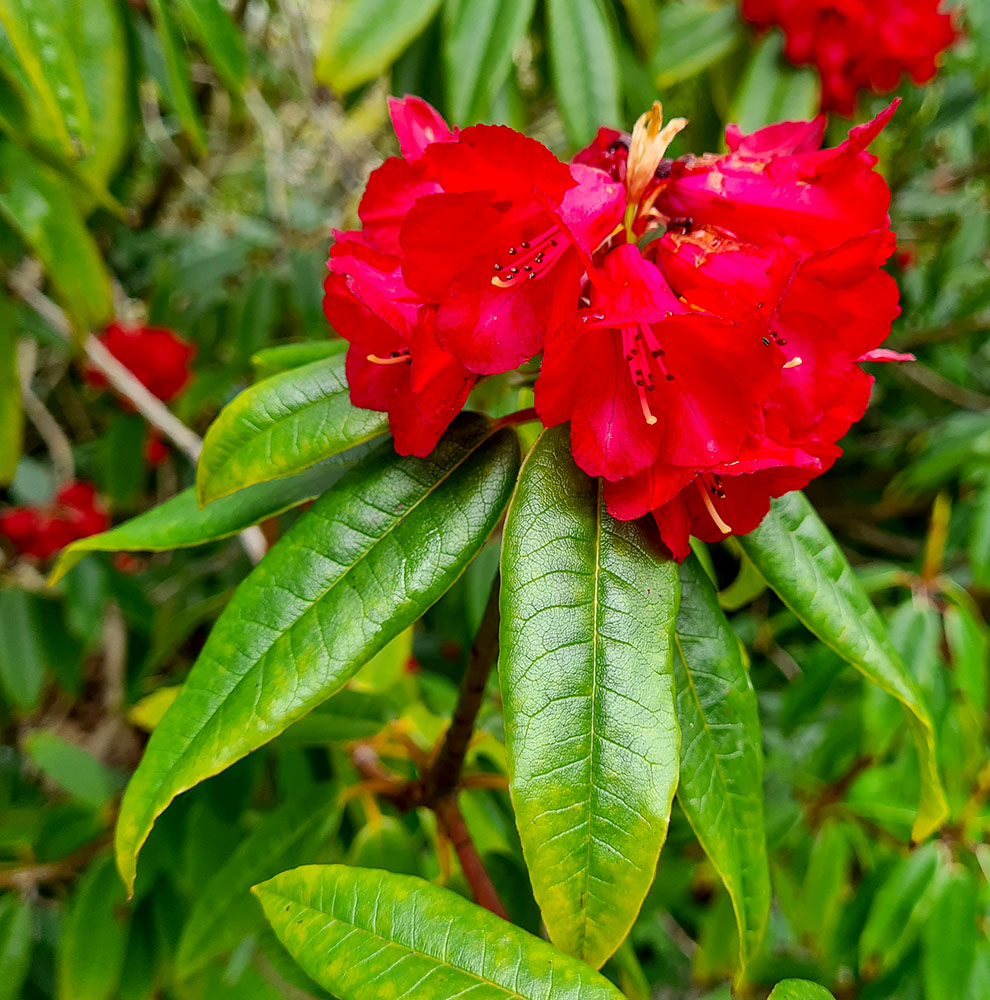
Commencing then in February and through March comes R. barbatum, figured in Sir Joseph Hooker’s
work on The Rhododendrons of Sikkim Himalaya, a species not sufficiently credited with hardiness, but
which is without doubt a truly hardy and satisfactory species here. The plant may at any time be recognized by the peculiar bristles which adorn the petiole of each leaf, which is lanceolate, and not adorned with that distinct colour on its under-side which renders several other species so attractive, whether in or out of bloom. The bark is smooth and polished, and of a bright purplish tint. The trusses consist of a number of blood-red bells, and are freely produced on trees of a certain age, and as at Singleton Abbey there are some twenty or twenty-five plants, which annually bloom with great freedom, it has undergone a very satisfactory apprenticeship down here.
Following this comes Rhododendron Thomsoni, resembling barbatum in tone of colour, with a looser truss, and larger individual blossoms, following barbatum in point of time, and quite distinct in its neat cordate foliage. This species sheds its foliage annually in October, the old leaves turning golden before being shed ; but as the young fronds have already set, it retains its evergreen character. It is a free-flowering species, and an especial favourite
of mine, the black spots in the interior of the corolla setting off each of the fine waxy blood-red bells, with their peculiar neat little setting of leaves, in a very fascinating manner. A plant at Singleton has this year produced about 500 trusses.
At this same time, too, comes R. ciliatum, dwarfer, and very floriferous, whitish, tinted with lilac, and sweet-scented. The smallest plants seem prone and even anxious to bloom, and from its neat compact habit it is invaluable as a foreground plant.
R. campanulatum also blooms in March and April, though the species is at any time worth growing for its strikingly beautiful foliage ; dark green above, it is beneath of a rich brick-red hue, which contrasts strongly, and is a very welcome addition to the few points of interest found throughout the winter. The figures of this species in the Botanical Magazine.No. 3759, and of Wallichii, show that it is variable, but it is none the less useful, and I strongly recommend it. This campanulatum is the evident progenitor of some remarkable hybrids at Singleton, which must be seen to be appreciated ; but I am constrained to attempt a description of one which, alas I was broken in last October’s disastrous gale, but of which I possess a photograph. The bloom-truss combines three essential qualifications :—
1. The truss is well and conically set up.
2. Each pip is a well-shaped campanulate bell.
3. Each pip is of a pure white, very richly spotted with a dark purple blotch, and constitutes, in my humble judgment, the finest and one of the most constant hardy hybrids I have ever seen. The bloom time is Easter, and as it continues for some weeks at Easter an abundance of trusses can be cut for church decoration ; and need I say that it has year after year been laid under heavy contribution at a time when such flowers are in such special request. Being informed that as many as 200 trusses had been cut off for Easter Sunday from this one plant without their being missed, I made it my business last year to test this statement by attempting to reckon the total
number of them, and I found upwards of 1,100. Strict accuracy was out of the question, but I think there were fully 1200, the height of the plant being about 20 feet, well furnished and bloomed.
But, to go back to the species, it is not alone for their bloom the species of Rhododendrons are worth growing. The foliage of some is most striking and grand, and cannot fail to attract the attention and admiration of the beholder.
Here at Singleton Rhododendron Falconeri grows to a height of 18 feet, and is nearly as much through ;
the individual leaves are 18 inches in length by 7 inches wide ; dark glaucous green above, and thickly
coated beneath with a soft ferruginous woolly tomentum, which adds marvellously to their peculiar and striking beauty. The bloom is a straggling and somewhat awkward loose collection of white, bell-shaped blossoms, and has been hitherto sparingly produced ; but the great attraction of this noble species lies in its leaves, which undoubtedly constitutes it the finest outdoor hardy foliage plant I have seen in Great Britain.
Next to R. Falconeri, in its striking foliage and with a finer inflorescence, comes what is supposed to be R. eximium, a species not figured in Hooker’s Rhododendrons of the Sikkim Himalaya or in the Botanical Magazine. The plants at Singleton are 18 to 20 feet high, well furnished throughout. Two are now blooming, one having fourteen trusses, and the other six, which are individually of commanding size and appearance, consisting as they do of forty or more
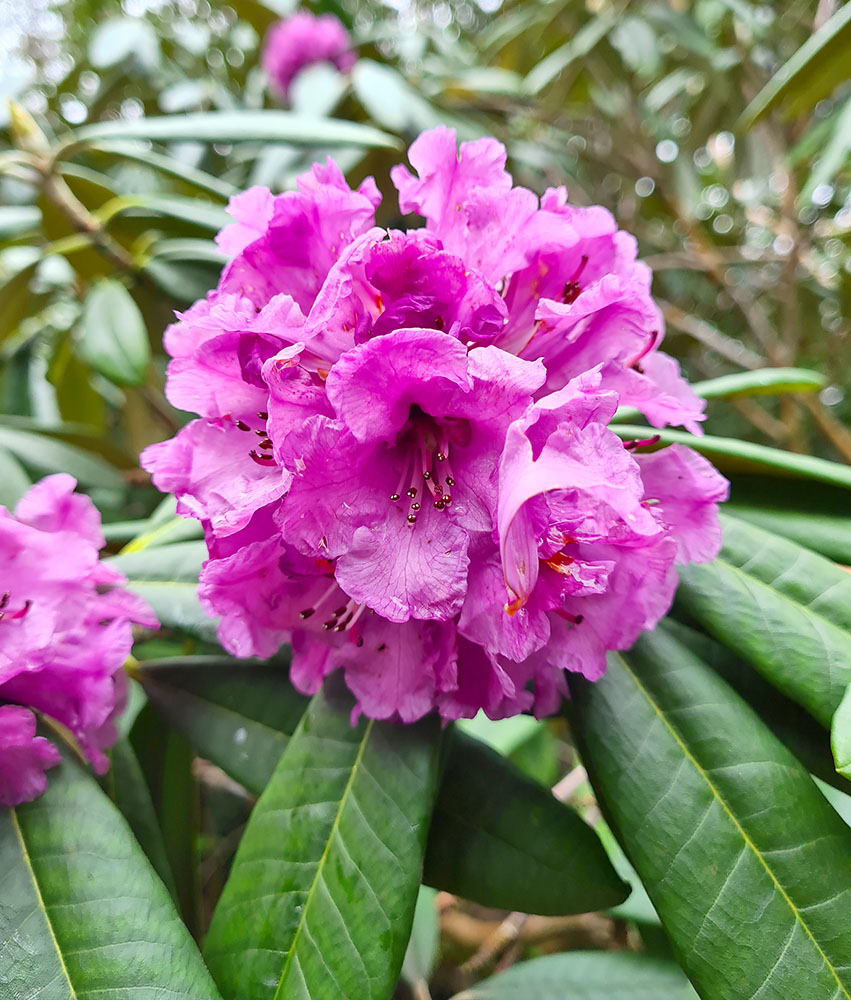
pips, each 2 inches at least in diameter. The shape of the flower is an open bell and the colour a pale purple, opening much darker, and dying off very much paler than the typical colour at mid-season. The individual leaves are not quite so large as those of R. Falconeri, and differ from them chiefly in the tomentum on the inferior side of the leaves being less richly coloured ; yet some of the leaves, out of reach of measurement— some 20 feet from the ground, where the plant seems to have luxuriated in the fostering shelter of a large overspreading Pinus excelsa — cannot be much smaller than those on the adjacent Falconeri.
What is R. eximium ? I have small plants from Van Houtte under this name, and they agree with the old plants at Singleton in foliage, and it is under this name the plants I have described are grown. The bloom is like the R. Hodgsoni of Hooker’s book, but then the foliage disagrees ; and besides this there is another plant, as yet unbloomed, whose foliage resembles the Hodgsoni plate and description, and is quite distinct apparently from eximium.
Another distinct species with peculiar leaf and purple bloom is R. niveum, also an April bloomer.
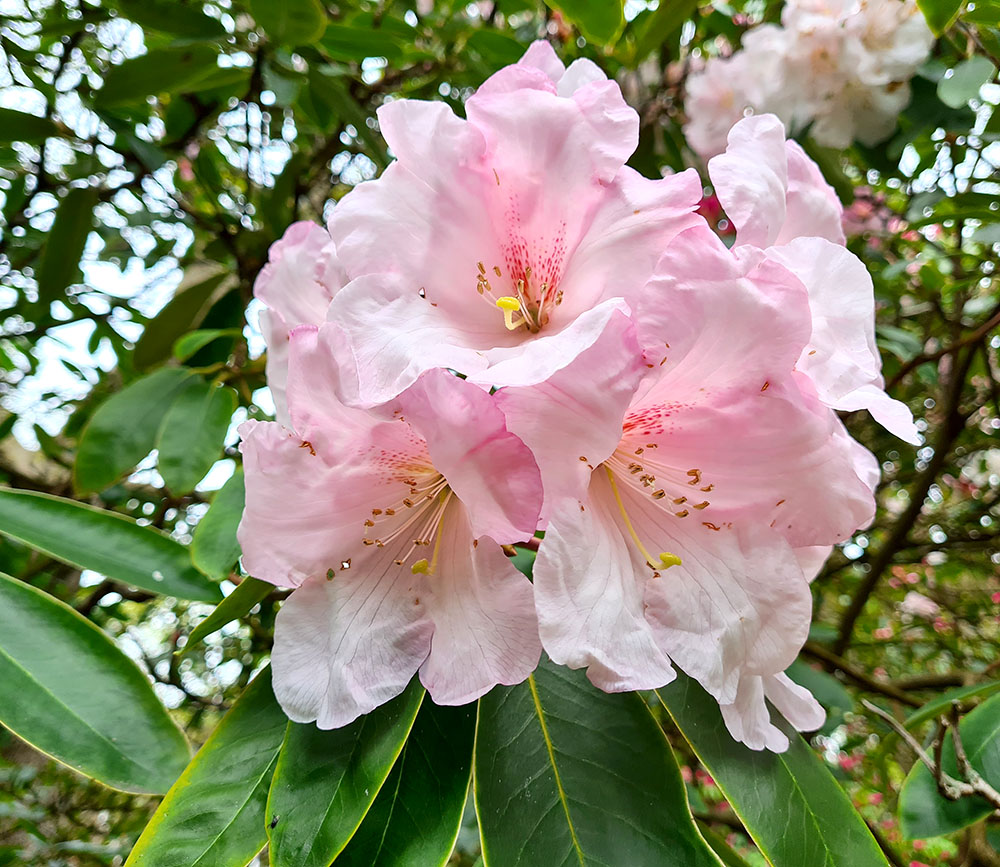
An old plant of R. arboreum album, Bot. Mag., 3290, relieved from a surrounding tangle of common ponticum, has gratefully rewarded me with its nearly pure white handsome trusses this April ; and R. cinnamomeum and R. ochraceum — both varieties, I think, of arboreum— the former pale pink, the latter white, have bloomed at the same time.
R. fulgens is another of the dark reds. I have not seen it as fine as R. Thomsoni, but it seems quite hardy.
R. nilagiricum has not bloomed, though the tree is an old one.
In addition to these some small plants of Campbelli and of Massangei have stood the frosts satisfactorily,
and will, I hope, prove quite hardy.
R. argenteum has been injured but not killed, and I hope will recover.
R. glaucum[synonym for R. viscosum?] is a pretty dwarf little species with a peculiar aromatic smell, very floriferous, quite hardy, and useful as a foreground plant.
R. ferrugineum (the Rose des Alpes) and its hybrids is subject to the attacks of rabbits— unlike in this respect to other species, as well as Azaleas, which rabbits do not touch.
R. Edgeworthii and R. Sesterianum were grown out-of-doors and bloomed with some freedom at Singleton for some years, but the winter appeared to injure them and the plants were therefore brought into the conservatory, where they now flourish.
R. Dalhousiie, too, grew out-of-doors, but the bitter winter of 1879-80 killed it, and it was this loss that induced the watchful eye of Mr. Harris, the careful and clever head gardener in charge of these lovely gardens, to move the above-named R. Edgeworthii and R. Sesterianum into the protected quarters, where they are now (April 22) in full luxuriance of their bloom,
R. Macnabi, however — which is, I believe, a hybrid of R. Edgeworlhii — is flourishing, and blooming freely by the side of R. Falconeri in the open ground. These plants were raised from seed given to Mrs. Vivian by Lord Dalhousie and Mr. Edgeworth (after whom two of the noblest species are respectively named) and Col. Sykes, about the year 1846, on the occasion of a visit paid by them to Singleton. What other species may have been reared from this seed and succumbed to the severities of the winters since then I do not know. I only know that those plants now growing are the very picture of robust and luxuriant health, and having withstood two winters of intense severity without injury, are practically safe ; and as years advance the trees have become more and more inured to our uncertain climate, and have borne seed, some of which, by Mrs. Vivian’s kindness, I am rearing, and which ought to produce a race at least equal to their parents (more I cannot expect) in hardiness.
There is one point I must name to deprecate — that is, the naming of hybrids with a quasi specific appellation. Thomsoni I know, and Hodgson I know, but who is Jackson ? I should have looked for a congener worthy of such a fraternity, but lo ! a hybrid. It is a misuse of a botanical privilege to latinise a trivial name into a botanical name— misleading and mischievous. I do not the least object to hybridisation itself : who that has seen the brilliant results
obtained by those exhibitors who will shortly be delighting the public with their May and June flowering sorts can do so ? I only ask for a prolongation of the season, and I have been struck by the apparent absence of the blood of my favourite Thomsoni, which I should have expected to have proved a most useful ally. Ascot Brilliant is the only one I can now recal which seems undoubtedly to show their parentage.
I cannot close this without a word of recognition of the pride and care with which the plants are tended by Mr. Harris, the intelligent and able gardener who has charge of them, and of the interest taken in them by the venerable lady to whom they belong ; and I can only wish they may both live long to continue the enjoyment of plants which, alas ! are as scarce as they are beautiful.
A writer in the Garden, of last autumn, tells us of species he finds hardy in Southern Ireland, beyond those plants of which I now write. I know few in South Wales, but surely in Ireland or Devonshire, or Cornwall, an experience has been gained of some of these species which would be very acceptable in your columns.
John T. D. Llewelyn, Penllergare, Swansea.