Effects of the Winter of 1853-1854
The Journal of the Horticulture Society of London published an article in 1855, looking into the effects of the winter of 53/54 and reporting on it from the standpoint of some 27 properties from around the UK, one of which was Singleton. William Barron, presumably head-gardener to John Henry Vivian supplied the information.
The actual article is some 60 pages long and I will only list the species mentioned as being at Singleton. The species given is followed with a remark on the plants health and other vital info
William Barron states: “this has been the most severe winter we have had for many years; during January we had from 7-16 degrees Fahrenheit (-9 to -14 degrees Celsius) and from April 4-7 degrees Fahrenheit (-14 to -15 degrees Celsius)”.
The List
- Abies Jezonensis – hardy
- Abies Morinda – injured in spring frost
- Abies Douglasi – never thrives
- Abies Brunoniana – two feet in height, injured in spring frost
- Abies Nordmanniana – quite hardy
- Abies (Cedrus) Deodara – uninjured
- Abies (Cedrus) Atlantica – uninjured
- Aloysia – 20feet high, against the house, uninjured
- Araucaria imbricata – stands sea breezes well
- Araucaria Braziliensis – fine plant thirteen feet high, protected, slightly cut, but recovered
- Arbutus procera – uninjured
- Arbutus Andrachne – uninjured
- Benthamia fragifera – uninjured
- Camellia double red – suffered considerably
- Cryptomeria japonica – uninjured
- Cunninghamia sinensis – 32 and 18 feet high, fine plants, sheltered by plantations, had the tips slightly cut
- Cupressus funebris – safe from frost
- Cupressus Goveniana – safe
- Cupressus macrocarpa – safe
- Cupressus torulosa – uninjured
- Escallonia – did not suffer in the least
- Fitz-Roya – uninjured
- Juniperus recurva – uninjured
- Libocedrus chilensis – quite safe
- Libocedrus Doniana – protected by branches, uninjured
- Pinus Llaveana – untouched
- Pinus Devoniana – leaves browned
- Pinus Gerardiana – leaves browned
- Pinus Hartwegi – leaves browned
- Pinus macrophylla – leaves browned
- Pinus patula – leaves browned
- Pinus radiata – leaves browned
- Pinus Bethamiana – untouched
- Pinus insignis – leaves browned
- Pinus Russelliana – leaves browned
- Pinus tuberculata (?) – leaves browned
- Pinus Montezumae – leaves browned
- Pinus cembroides – slightly hurt
- Pinus halepensis – untouched
- Pittosporum Tobira – uninjured
- Saxo-gothaea conspicua – uninjured
- Taxodium sempervirens – suffered a little
- Taxus elegantissima – untouched
- Taxus Dovastoni – untouched
- Taxus aurea – uninjured
- Thuja variegata – untouched
- Thuja flagellifotmis – untouched
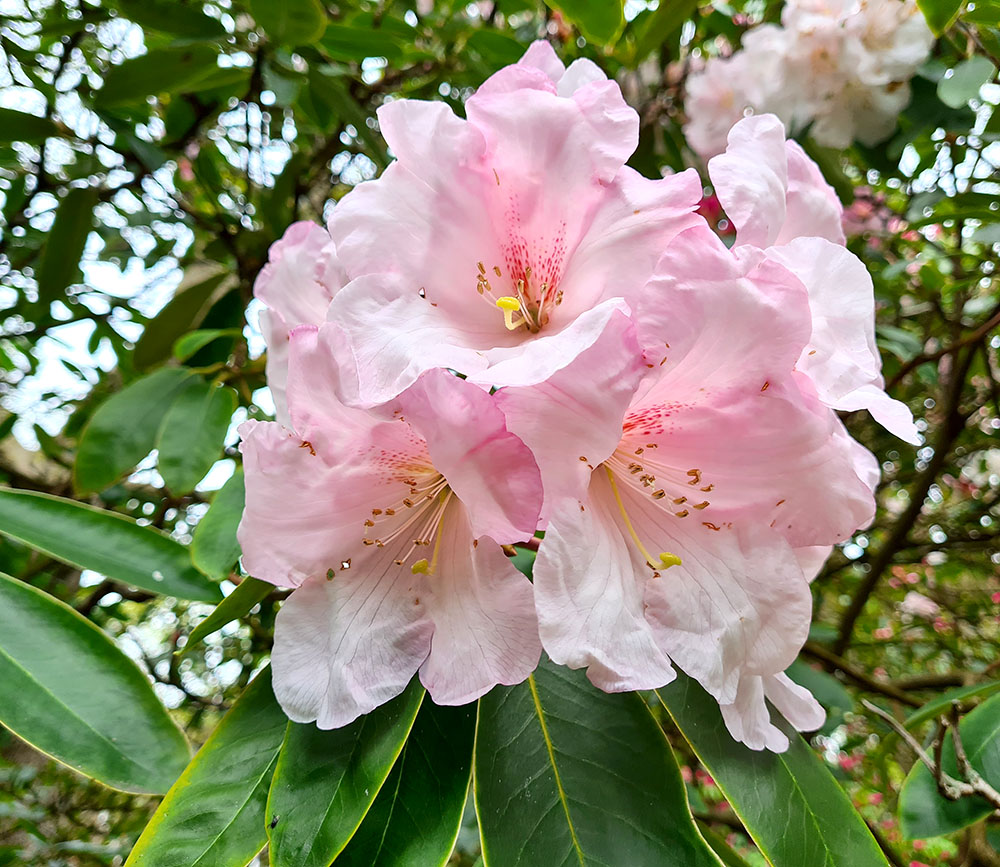
A very interesting point for anyone interested is that of the 33 different Rhododendrons specified, none are given as Singleton.
The original article can be found here.